For shippers
Updated September 27, 2026
A carrier owns the trucks and moves your vehicle. A broker arranges the move and hands it to a carrier. Either way, a carrier’s truck and driver do the hauling.
Both must be registered with the Federal Motor Carrier Safety Administration (FMCSA). You can look up either one for free before you book.
We have moved cars since 1999. We run our own trucks, and we also have a brokerage department. So we can explain both sides plainly, without selling you on one.
What Is an Auto Transport Carrier?
A carrier is the company whose truck and driver actually haul your vehicle. Federal law defines a motor carrier as “a person providing motor vehicle transportation for compensation.”
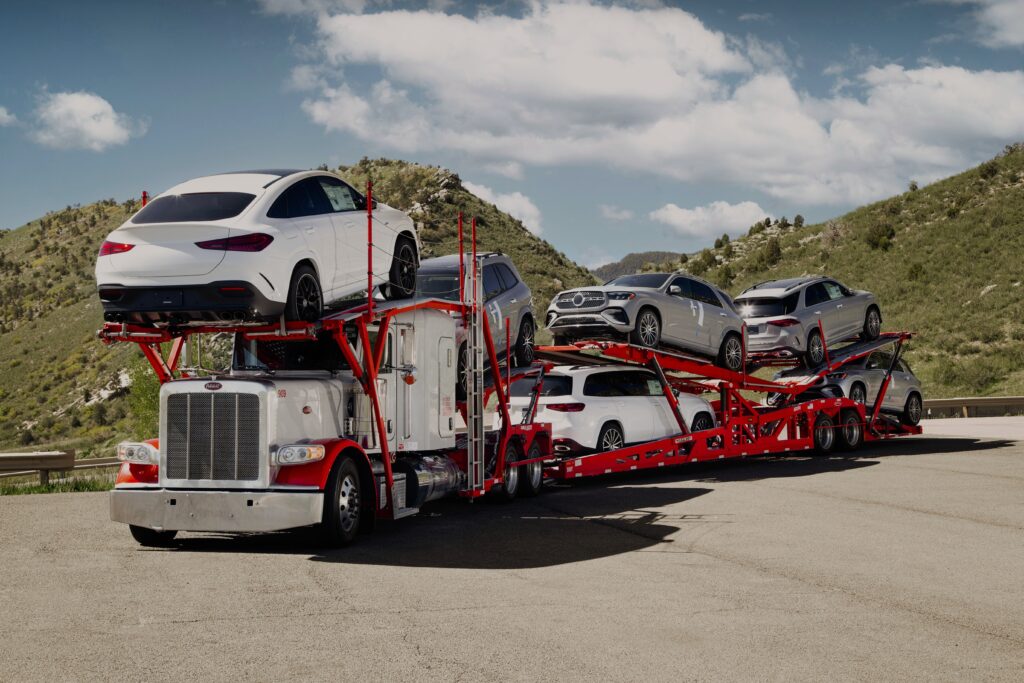
In auto transport, that usually means a car hauler: a tractor and a trailer built to carry vehicles on two decks. Our rigs carry up to nine cars.
Carriers that haul freight between states for pay must carry insurance. For a truck like a car hauler, the federal minimum for public liability is $750,000. That is the floor, not a promise of what any one carrier carries.
What Is an Auto Transport Broker?
A broker arranges your move but does not haul it. The broker finds a carrier, sets up the job, and the carrier’s truck picks up your vehicle.
The federal rule says a broker is “a person who, for compensation, arranges, or offers to arrange, the transportation of property by an authorized motor carrier.” A carrier that books loads it will haul itself is not acting as a broker.
Brokers have their own federal rules:
- A $75,000 bond or trust fund. A broker must keep a $75,000 surety bond or trust fund in effect. It pays shippers or carriers if the broker fails to carry out its deals.
- Its own name. A broker may only do business in the name it is registered under.
- No posing as a carrier. A broker may not claim to be a carrier. Its ads must show that it is a broker.
Broker vs Carrier Side by Side
Here is how the two roles compare on the points shippers ask about most.
| The question | Carrier | Broker |
|---|---|---|
| Owns the trucks? | Yes. Its own truck and driver haul your vehicle. | No. It hires a carrier to haul it. |
| Who do you talk to? | The company that is moving your vehicle. | The broker, who passes details to the carrier. |
| What it registers for | Authority to haul as a motor carrier. | Authority to arrange moves as a broker. |
| Federal money rule | Insurance, at least $750,000 public liability for trucks like car haulers. | A $75,000 surety bond or trust fund. |
| Who is liable for loss or damage in transit? | The law puts that on the carrier that issues the receipt or bill of lading and the carrier that delivers. | The broker does not haul the vehicle. Ask which carrier will. |
This is a plain summary of federal rules, not legal advice. The sources are listed at the end of this page.
When a Broker Makes Sense and When a Carrier Does
Neither one is always better. It depends on your move.
A carrier can fit when
- You want to deal with the people who run the truck.
- You ship on the same routes again and again, like a dealer or a fleet.
- You want one company answering for pickup, the haul, and delivery.
A broker can fit when
- No single carrier runs your route.
- You need extra trucks on short notice.
- You want one contact who shops the job to several carriers.
Whichever you pick, ask one question before you book: whose truck will carry my vehicle? A good company answers it plainly.
How to Check Any Auto Transport Company
You do not have to take anyone’s word for it. FMCSA’s free SAFER system shows a company’s federal record.
- Get the numbers.Ask for the company’s USDOT number and its MC number. A real carrier or broker will give them to you.
- Search SAFER.Go to the SAFER Company Snapshot. Search by USDOT number, MC number, or company name.
- Read the status.Check that the USDOT status is active and see what the operating authority covers, such as “Motor Carrier of Property.”
- Match the name.Compare the legal name and any “doing business as” name with the name on your quote and paperwork.
- Check the filings.The snapshot links to FMCSA’s licensing and insurance record, where the company’s filings are listed.
Red flags
- The company will not give you a USDOT or MC number.
- The name on your paperwork does not match the name in SAFER.
- The company says it is a carrier, but its record does not show carrier authority.
- No one can tell you which carrier will haul your vehicle.
Questions to ask before you book
- Are you the carrier or the broker on this move? The answer tells you who you will deal with on the road.
- Whose truck will carry my vehicle? Get the carrier’s name, then look it up in SAFER too.
- How will I track it? Ask how you will see where your vehicle is and how delivery is confirmed.
- What gets recorded at pickup and delivery? A condition report records the vehicle’s condition, and the bill of lading is the receipt for the shipment.
How Accelerated Works
We have been moving cars since 1999. Here is how our side works, in the same words our own pages use.
- Our own trucks. Our dealer service runs on “our nationwide fleet of trucks along with our brokerage department.”
- A brokerage department. For personal vehicles, our brokerage division lets us move your car in the most efficient way possible.
- Screened partners at peak volume. Beyond our own fleet, we can draw on a large pool of pre-screened auto transport partners.
- Tracking on every truck. Every one of our trucks has GPS tracking and Electronic Proof of Delivery.
What we require of the carriers we use
Independent carriers who haul our freight sign on as sub-haulers. Before they run a load, we require:
- AuthorityActive operating authority, with their own MC and DOT numbers
- Time in businessAt least 6 months in business as a carrier
- Liability$1 million in auto liability coverage
- CargoCoverage that grows with how many cars the trailer holds, with Accelerated listed as certificate holder
Our Risk Management department monitors the safety and compliance of our fleet and our sub-haulers. Want to know whose truck will carry your load? Ask us when you book.
Shipping one vehicle or a hundred? Talk to our team about your move.
Broker vs Carrier FAQs
Is it bad to use an auto transport broker?
No. A registered broker is a legal, common way to ship a vehicle. What matters is that the broker is registered, has its bond in place, and tells you which carrier will haul your vehicle.
Who is responsible if my car is damaged in transit?
Federal law (49 U.S.C. 14706) makes the carrier that issues the receipt or bill of lading, and the carrier that delivers, liable for actual loss or injury to the property. This is a summary, not legal advice. Before you book, ask which carrier will haul your vehicle and whose insurance covers it on the road.
How can I tell if a company is a broker or a carrier?
Ask for its USDOT and MC numbers, then search them in FMCSA’s SAFER Company Snapshot. The record shows the company’s legal name and what its operating authority covers. By federal rule, a broker’s ads must also show that it is a broker.
Do auto transport brokers need a bond?
Yes. Under 49 CFR 387.307, a broker must have a $75,000 surety bond or trust fund in effect. FMCSA will not register a broker until it is in place.
Does Accelerated haul my vehicle or broker it?
We run our own trucks and we have a brokerage department, so it depends on the move. Ask us which one will carry your load when you book.
Ship With a Company That Runs Its Own Trucks
We have hauled vehicles since 1999, with GPS tracking and Electronic Proof of Delivery on every truck. See what we move, or talk to our team now.
Prefer the phone? Call (720) 200-3100, Monday to Friday 7:00 AM to 5:00 PM and Saturday 8:00 AM to 12:00 PM.
Sources
- 49 U.S.C. 13102, definitions of broker and motor carrier
- 49 CFR 371.2, definition of a broker
- 49 CFR 371.7, broker misrepresentation
- 49 CFR 387.307, property broker surety bond or trust fund
- 49 CFR 387.9, minimum levels of financial responsibility
- 49 U.S.C. 14706, liability of carriers under receipts and bills of lading
- FMCSA SAFER Company Snapshot