
Rules of the road
Updated September 27, 2026
Car haulers run under the same federal hours-of-service rules as every property-carrying truck driver. Four limits shape the day:
- 11 hours of driving after 10 hours off duty.
- No driving after the 14th hour since you came on duty.
- A 30-minute break after 8 hours of driving.
- 60 or 70 hours on duty in 7 or 8 days, reset by a 34-hour restart.
The rules are the same for everyone. The day is not. A car hauler loads and unloads every vehicle on the rig, and that time counts. This guide walks through each rule with that in mind, then shows how the split sleeper berth works on a real day.
Why Loading Time Matters More for Car Haulers
In a lot of freight, the shipper’s crew loads the trailer. A car hauler does the loading.
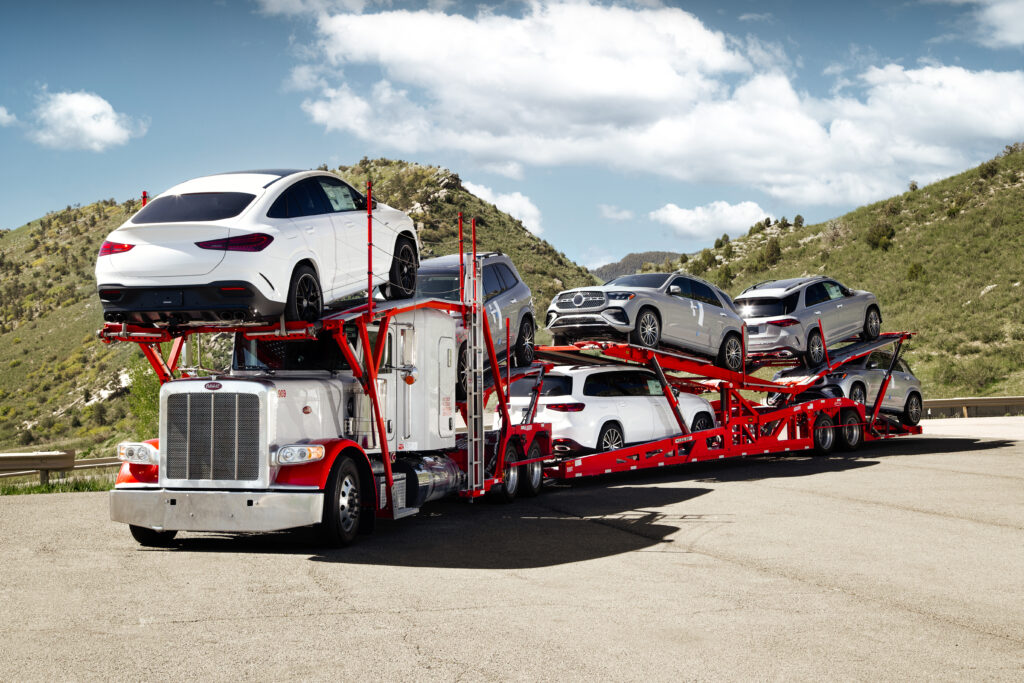
You drive each vehicle up the ramps, set the decks, and strap it down. On our rigs that can be up to nine cars, with a truck package on most rigs so cars ride on the tractor as well as the trailer.
Federal rules say all of that is on-duty time. The definition covers:
- Loading or unloading the truck, or helping with it
- Watching the truck while it is loaded or unloaded
- Giving or getting receipts for the cars you load or drop
- Inspecting, servicing, or fixing the truck
- Waiting at a plant, terminal, or yard to be dispatched

Loading does not count against your 11 hours of driving. It does run your 14-hour clock, and it adds to your 60 or 70-hour total. A slow load at a port or rail ramp can cost you driving time later in the day.
The 11-Hour and 14-Hour Rules
Start with 10 hours in a row off duty. That opens a new shift.
The 11-hour driving limit
Inside that shift, you may drive up to 11 hours total. Only time behind the wheel counts here.
The 14-hour window
Once you come on duty, a 14-hour clock starts.
After the 14th hour you may not drive again until you take another 10 hours off. The clock keeps running through loading, fuel stops, and meal breaks. Only a qualifying split sleeper period, covered below, sets it aside.
For a car hauler, the window is usually the tighter limit. Two hours loading at the start and two more unloading at the stops can leave you with hours to drive but no window to drive them in.
The 30-Minute Break Rule
You may not drive once 8 hours of driving have passed without a break of at least 30 minutes in a row.
The break does not have to be off duty. Any 30 minutes in a row not driving counts, including off-duty time, sleeper berth time, and on-duty time like unloading. So 30 minutes or more unloading at a dealer can meet the break, as long as you do not drive during it.
The 60/70-Hour Limit and the 34-Hour Restart
The weekly limit counts every on-duty hour, driving or not:
- 60 hours in 7 days if your carrier does not run trucks every day of the week.
- 70 hours in 8 days if your carrier runs trucks every day.
Once you hit the limit, you cannot drive until older hours roll off the count, or until you take a restart. A 34-hour restart is 34 or more hours in a row off duty. It starts your 7 or 8-day count over at zero.
Loading counts toward this total. A week of heavy loading uses up your hours faster than the miles alone would show.
How the Split Sleeper Berth Works
The split sleeper berth rule lets you take your 10 hours off in two pieces instead of one. It works if all of these are true:
- You use no more than two rest periods.
- Neither period is shorter than 2 hours in a row.
- One period is at least 7 hours in a row in the sleeper berth.
- The two periods add up to at least 10 hours.
So the common pairings are 7 and 3 or 8 and 2. You can take either one first.
The shorter one can be off duty or in the sleeper. The 7-hour or longer one must be in the sleeper berth.
Why it helps
Once you complete a pair, neither period counts against your 14-hour window. You then figure your hours again from the end of the first period. The driving you did right before and right after each rest must add up to 11 hours or less, and it must fit inside the 14-hour window.
A worked example
Here is one day on a 3 and 7 split. The times are plain clock times.
| Time | What you do |
|---|---|
| 6:00 to 8:00 am | On duty Load the rig. On duty, not driving. Your 14-hour clock starts at 6:00. |
| 8:00 am to 2:00 pm | Driving Drive 6 hours. |
| 2:00 to 5:00 pm | Off duty Rest 3 hours off duty. This is the first period, and it also covers your 30-minute break. |
| 5:00 to 10:00 pm | Driving Drive 5 hours. That is 11 hours of driving around the first rest, the most allowed. |
| 10:00 pm to 5:00 am | Sleeper berth Rest 7 hours in the sleeper berth. The pair is done: 3 plus 7 makes 10. |
| 5:00 am | Recount Count again from 5:00 pm, the end of the first period. You drove 5 hours since then, so you have 6 hours of driving left. Your window runs to 2:00 pm. |
The new window starts at 5:00 pm and runs 14 hours. The 7-hour sleeper period does not count, so it ends 21 clock hours later, at 2:00 pm. Check your log against this math before you plan a split.
Sleeper berth vs off duty: both are rest. Sleeper time is logged in a sleeper berth that meets federal rules. The 7-hour part of a split must be in the sleeper. The shorter part can be either.
Run your hours on steady plant, port, and rail freight.
The Adverse Driving Conditions Exception
Bad weather or bad roads can stretch your day. If you run into adverse driving conditions and cannot safely finish the run in time, you may drive up to 2 more hours past the normal limits. You can use them to finish the run or to reach a safe place for you, the truck, and the load.
Adverse conditions mean snow, ice, sleet, fog, other bad weather, or unusual road or traffic conditions that you did not know about, and could not have known about, before you started. That means before your duty day, or before you started driving again after a qualifying rest.
A storm in the morning forecast does not count. Neither does traffic your carrier knew about when it dispatched you.
Winter storms in the mountains are one place this comes up. Our guide to the Colorado chain law for truckers covers chain season on I-70 and the other passes.
Personal Conveyance
Personal conveyance means moving your truck for personal reasons while you are off duty. FMCSA guidance says you may log it as off duty only when your carrier has relieved you from work and all duties. It can be used even when the truck is loaded, because the load is not moving for the carrier’s business at that time.
FMCSA’s examples that can count include:
- Driving to the nearest reasonable, safe place to rest after loading or unloading
- Going from your lodging to a restaurant
- Moving the truck when a safety official asks you to
Examples that do not count include:
- Passing up open rest spots to get closer to your next pickup or drop
- Driving to your carrier’s terminal after loading or unloading
- Driving empty to get your next load
Carriers can set tighter limits or ban personal conveyance. Always check your carrier’s policy first.
Haul Cars With Accelerated
We hire drivers with 3 years of CDL-A driving and 1 year of verifiable 9-car experience. All of our contract drivers keep 82% of the truck’s gross, with GPS tracking and Electronic Proof of Delivery on every load. See car hauler jobs at Accelerated, or start your application now.
The application takes a few minutes from your phone.
Hours of Service FAQs for Car Haulers
Does loading and unloading count as on-duty time?
Yes. Federal rules count loading, unloading, helping load, and watching the truck while it is loaded as on-duty time. It does not count against the 11-hour driving limit, but it runs the 14-hour window and adds to your 60 or 70-hour total.
Can unloading count as my 30-minute break?
Yes. The break can be any 30 minutes in a row not driving, including on-duty time. Thirty minutes or more of unloading counts, as long as you do not drive during it.
How does the split sleeper berth work?
You take your 10 hours off in two periods. Neither can be under 2 hours, one must be at least 7 hours in the sleeper berth, and together they must reach at least 10 hours, as in 7 and 3 or 8 and 2. Neither period counts against your 14-hour window once the pair is done.
What is the 34-hour restart?
34 or more hours in a row off duty. It resets your 60-hour or 70-hour count to zero, so a new 7 or 8-day period begins.
What is the difference between sleeper berth and off duty?
Both are rest time. Sleeper berth time is spent in a sleeper that meets federal rules. For a split, the 7-hour or longer period must be in the sleeper berth, while the shorter period can be off duty or in the sleeper.
Can I use personal conveyance with cars on the trailer?
FMCSA guidance says personal conveyance can be used even when the truck is loaded, as long as you are off duty and the move is for personal reasons, not the carrier’s business. Carriers can limit or ban it, so check your carrier’s policy.
Sources
Last checked September 27, 2026. Federal rules and guidance change. Confirm the current rules with FMCSA or the eCFR before you plan around them. This guide is a plain-language summary, not legal advice.