
Rules of the road
Updated September 27, 2026
An ELD, or electronic logging device, records your hours of service. It connects to the truck’s engine and logs your driving time on its own.
If you must keep a log, federal rules say you must use an ELD unless one of these exceptions fits:
- You keep logs on 8 days or fewer in any 30-day period.
- You drive in a driveaway-towaway operation, where the truck you drive is the shipment.
- Your truck was built before model year 2000.
This guide covers what an ELD does, who has to use one, and each exception in plain words. It also settles a question the vendor guides skip: whether the driveaway-towaway exception covers a car hauler.
What Is an ELD?
An ELD is a device that syncs with the truck’s engine to record driving time automatically. Congress required it in the MAP-21 highway law, and FMCSA wrote the rule that carries it out.
The ELD keeps your record of duty status, the log that shows how you spent each day. It uses the same four duty statuses a paper log does:
- Off duty
- Sleeper berth
- Driving
- On duty, not driving
An ELD does not change the hours you may drive. FMCSA says the ELD rule leaves the hours-of-service limits and exceptions as they were. It only changes how the hours are recorded.
Who Must Use an ELD
A carrier must require each driver to log duty status for every 24-hour period. For most drivers, that log must be kept on an ELD. The rule has applied since December 18, 2017.
Your carrier sets up the device and your account. The rules say the carrier must:
- Use only an ELD on FMCSA’s registered list
- Give you your own login, tied to your driver’s license
- Keep an ELD packet in the truck with instructions for sending your logs to an officer, instructions for malfunctions, and blank paper logs for at least 8 days
You must send your log to your carrier within 13 days of the day it covers.

ELD Exemptions
The rule lets a carrier use paper logs instead of an ELD in four cases:
| Exception | What it covers |
|---|---|
| 8 days in 30 | Drivers who need a log on no more than 8 days in any 30-day period |
| Driveaway-towaway | The vehicle being driven is part of the shipment being delivered |
| Motor home or RV | A driveaway-towaway run moving a motor home or an RV trailer |
| Pre-2000 truck | A truck built before model year 2000, shown by the VIN on its registration |
These drivers are not exempt from logging. They still keep a record of duty status on paper, on the grid the rule shows.
Driveaway-Towaway vs. Car Hauling
This is the exception that trips up people who move vehicles for a living. The name sounds like car hauling. The rule says otherwise.
A driveaway-towaway operation moves an empty vehicle on its own wheels, with at least one set of wheels on the road. The federal definition lists moves like these:
- Between a manufacturer’s plants
- From a manufacturer to a dealer or buyer
- From a dealer to a buyer or lessee
- To a terminal or repair shop after a crash or breakdown
- By saddle-mount or tow-bar
For the ELD exception, the vehicle you are driving must be part of the shipment. Think of a driver delivering a new truck from the plant to the dealer.
Why a loaded car hauler does not qualify
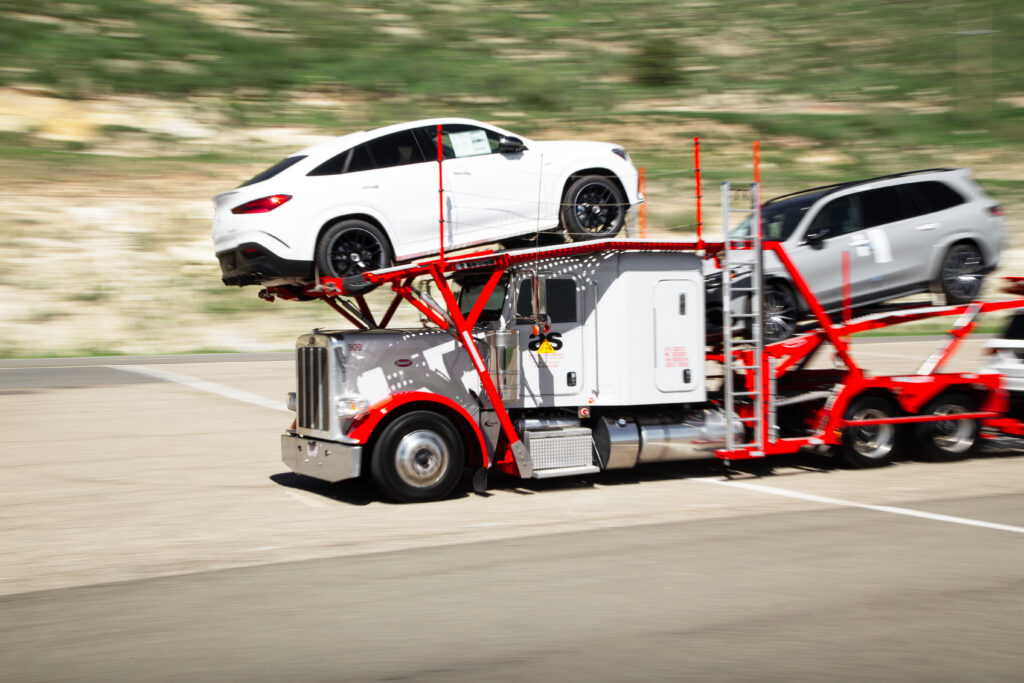
On a car hauler, the cars ride on the trailer and on the truck package over the cab. They are not rolling on their own wheels. The tractor you drive is not being delivered either.
The bottom line: the driveaway-towaway exception does not cover a loaded car hauler. A car hauler who must keep logs uses an ELD unless another exception fits, like the 8-days-in-30 rule or a pre-2000 truck.
Know the rules for hauling cars? Put them to work on our rigs.
The Short-Haul Exception
Some local drivers do not keep a log at all, so they need no ELD. The 150 air-mile short-haul exception applies when all of these are true:
- You stay within a 150 air-mile radius (172.6 road miles) of your normal work reporting location.
- You return to that location and are released from work within 14 hours in a row.
- You get at least 10 hours in a row off duty between each 14-hour shift.
- Your carrier keeps accurate time records for 6 months, showing when you start, how long you work, and when you are released.
A run that takes you past 150 air miles, or keeps you out past 14 hours, does not fit. That run must be logged, and for most drivers that means an ELD.
Paper Logs and When You Can Use Them
You may keep paper logs in two situations:
- An exception applies, such as the 8-days-in-30 rule or a pre-2000 truck. Your carrier can still choose to have you use an ELD.
- Your ELD breaks, until it is fixed or replaced.
A paper log goes on the graph grid shown in the rule. At each change of duty status, you write down the city and state, or a highway and nearby milepost.
If Your ELD Malfunctions
A broken ELD does not stop the clock. The rules give you three jobs:
- Tell your carrier.Note the malfunction and give your carrier written notice within 24 hours.
- Rebuild your log.Recreate your record for the current day and the 7 days before it on paper, unless you already have it or can get it from the ELD.
- Keep logging on paper.Keep a paper log until the ELD is repaired or replaced. If you are inspected, hand the officer your paper logs.
Your carrier then has 8 days to fix or replace the ELD. If it needs more time, it can ask FMCSA for an extension within 5 days of your notice.
A data diagnostic event is different from a malfunction. It flags a data problem, not a broken device. Follow your carrier’s and the ELD maker’s steps to clear it.
Haul Cars With Accelerated
We hire drivers with 3 years of CDL-A driving and 1 year of verifiable 9-car experience. All of our contract drivers keep 82% of the truck’s gross, with GPS tracking and Electronic Proof of Delivery on every truck. See the rigs and truck packages we run, or start your application now.
The application takes a few minutes from your phone.
ELD Rules FAQs
What is an ELD in trucking?
An electronic logging device. It syncs with the truck’s engine to record driving time automatically and keeps your record of duty status. It does not change the hours-of-service limits.
Who is exempt from the ELD rule?
Four groups keep paper logs instead: drivers who log 8 days or fewer in any 30 days, and driveaway-towaway drivers whose vehicle is the shipment. The others are drivers moving a motor home or RV trailer that way, and drivers of trucks built before model year 2000. Short-haul drivers who qualify need no log at all.
Are car haulers exempt from ELDs?
Not as car haulers. The driveaway-towaway exception covers a vehicle that is itself the shipment, driven or towed on its own wheels. A loaded car hauler carries the cars on the rig, so it does not qualify. Another exception, like a pre-2000 truck, could still apply.
What is the 150 air-mile exemption?
A short-haul exception. You stay within 150 air miles of your work reporting location, and return there to be released within 14 hours. You also get 10 hours off between shifts. Then you need no log, and your carrier keeps time records instead.
What do I do if my ELD stops working?
Give your carrier written notice within 24 hours, rebuild the current day and the past 7 days on paper, and keep paper logs until it is fixed. Your carrier has 8 days to repair or replace it.
Can I still use paper logs?
Yes, if an exception applies to you or while your ELD is broken. Otherwise, a driver who must keep a log must use an ELD.
Sources
Last checked September 27, 2026. Federal rules change. Confirm the current rules with FMCSA or the eCFR before you rely on them. This guide is a plain-language summary, not legal advice.
- 49 CFR 395.8, driver’s record of duty status and ELD exceptions
- 49 CFR 395.1, short-haul operations
- 49 CFR 390.5, definition of driveaway-towaway operation
- 49 CFR 395.22, motor carrier ELD responsibilities
- 49 CFR 395.34, ELD malfunctions
- FMCSA, Electronic Logging Devices
- FMCSA, ELD exemptions and waivers