Rules of the road
Updated September 27, 2026
Federal rules require each car on a car hauler to be restrained at the front and the rear with at least two tiedowns. Tiedowns that attach to the car must use the mounting points its maker designed for that purpose.
That rule sits on top of FMCSA’s general cargo securement rules, and you check the load again after you start rolling. Here is how it all fits together for a car hauler.
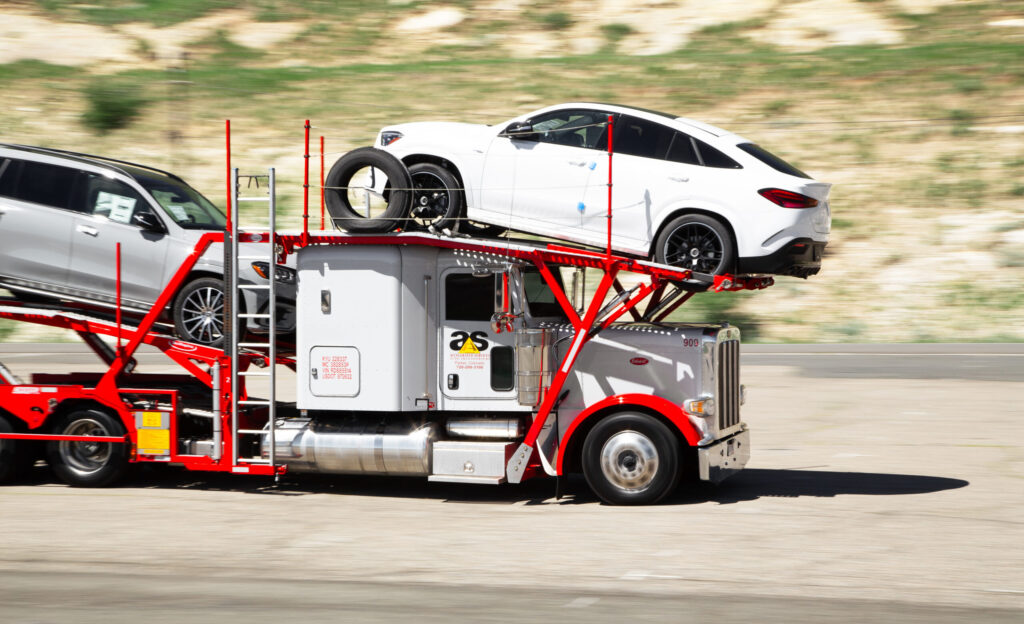
Our rigs carry up to nine cars, on the trailer and on the tractor. Every one of them has to arrive where it was loaded, with no shifting on the way. These are the rules that make that happen.
The General Securement Rules
FMCSA’s cargo securement rules are in 49 CFR Part 393, sections 393.100 to 393.136. They apply to trucks, truck tractors and trailers. The basic goal, from 393.100, is simple:
- Cargo must not leak, spill, blow off or fall from the vehicle.
- Cargo must not shift so much that it hurts the truck’s stability or handling.
The Forces a System Must Hold
Section 393.102 sets how strong a securement system must be. It must hold these forces without failing:
| Direction | Breaking strength | Working load limit |
|---|---|---|
| Forward | 0.8 g | 0.435 g |
| Rearward | 0.5 g | 0.5 g |
| Sideways | 0.5 g | 0.25 g |
Cargo that is not fully inside the vehicle also needs a downward force of at least 20 percent of its weight. Cargo secured the way sections 393.104 to 393.136 describe is treated as meeting these numbers.
Tiedowns and Working Load Limits
- Good condition. Under 393.104, no damaged or weak parts, such as cuts or cracks, and no knots.
- Stays fastened. Each tiedown must be attached so it cannot loosen, open or release in transit.
- Edge protection where a tiedown would rub or be cut on the cargo.
- Working load limit. Under 393.108, a tiedown’s limit is the lowest limit of any of its parts, or of the anchor points it hooks to. You can read it from the maker’s marking or the rule’s tables.
- The total. Under 393.106, the working load limits of the tiedowns on an item must add up to at least half its weight.
Rules written for a specific kind of cargo, like the car rule below, take precedence over the general rules where they add requirements.
The Rule for Automobiles, Light Trucks and Vans
Section 393.128 is the one written for car haulers. It applies to cars, light trucks and vans that each weigh 10,000 pounds or less.
49 CFR 393.128 at a glance
Every vehicle, restrained at the front and the rear, with at least two tiedowns, against movement in four directions:
- Side to side
- Forward
- Backward
- Up and down
- Designed mounting points. Tiedowns that attach to the vehicle’s structure must use the mounting points built for that purpose.
- Over the wheels. Tiedowns that fit over or around the wheels must hold the vehicle side to side, front to back, and up and down.
- Edge protectors. They are not required for synthetic webbing where it touches the tires.
- Heavier vehicles. A vehicle over 10,000 pounds must be secured under section 393.130 instead.
Official sources differ. You may see “two tiedowns at both the front and rear” in FMCSA’s older driver handbook on cargo securement, which reads like four. The current rule says restrained at the front and rear using a minimum of two tiedowns. The handbook dates from 2003 and is no longer on FMCSA’s site. Follow the current rule, and your carrier’s method.

How Car Haulers Load a Rig
Every carrier and every driver has a method, and it depends on the rig and the load. What does not change is that the rule applies to each vehicle, wherever it rides:
- Upper and lower decks. A loaded car hauler typically carries vehicles on two levels. Each one gets its own front and rear restraint.
- On the tractor. Most of our rigs have a truck package, the rack that lets you load cars on the tractor as well as the trailer. Those cars follow the same rule.
- Weight on your axles. Where each car rides changes how the weight sits on your axles. The federal bridge formula caps the weight on any group of two or more axles in a row.
- Your view and your exit. Under 392.9, nothing on the rig may block your view ahead or to the sides, or keep you from getting out of the cab.
If you come from another carrier, you already know how to load and secure a load of new vehicles. See the trailers and truck packages we run.
Know how to load and secure nine cars? Haul them with Accelerated.
Checking the Load on the Road
Securement is not a one-time job. Under 49 CFR 392.9, the driver of a truck or tractor must check the cargo and the devices holding it:
- Before you drive. The load must be spread right and secured, and your equipment fastened.
- Within the first 50 miles. Adjust the load or tiedowns, or add more, so nothing can shift or fall.
- Again as you go. Whenever you change duty status, or after 3 hours or 150 miles of driving, whichever comes first.
The rule does not apply to a sealed load you were told not to open, or to a load that cannot practically be inspected. Your load checks are part of your pre-trip inspection, and cargo securement is one of the items an officer looks at in a Level 1 DOT inspection.
For shippers
Securement and Damage-Free Delivery
If you ship vehicles, this is the part that matters to you. The rules require each vehicle on the rig to be held at the front and rear so it cannot move, and they require the driver to re-check the load on the road.
Every Accelerated load runs with GPS tracking and Electronic Proof of Delivery, so the delivery record is closed out electronically.
Haul Cars With Accelerated
We hire drivers with 3 years of CDL-A driving and 1 year of verifiable 9-car experience. All of our contract drivers keep 82% of the truck’s gross. See car hauler jobs at Accelerated, or start your application now.
The application takes a few minutes from your phone.
Cargo Securement FAQs
What are the FMCSA cargo securement rules for cars?
Under 49 CFR 393.128, each car, light truck or van of 10,000 pounds or less must be restrained at the front and rear against movement in every direction, using at least two tiedowns and the vehicle’s designed mounting points.
How many tiedowns does a car need on a car hauler?
At least two, restraining the vehicle at both the front and the rear. FMCSA’s general rule in 393.106 also says the tiedowns’ working load limits must add up to at least half the weight of the cargo they hold.
What is a working load limit?
It is the load rating the securement rules use for a tiedown. Under 49 CFR 393.108, it is the lowest limit of any part of the tiedown, or of the anchor points it uses, whichever is less.
How often do I have to check my load?
Before you drive, within the first 50 miles, and then whenever you change duty status or after 3 hours or 150 miles of driving, whichever comes first.
Does the car rule cover a heavy pickup on my deck?
Only if it weighs 10,000 pounds or less. A heavier vehicle must be secured under 49 CFR 393.130, the rule for heavy vehicles, equipment and machinery.
Sources
Last checked September 27, 2026. Federal rules change. Confirm the current rules with FMCSA and the eCFR. This guide is a plain-language summary, not legal advice.