
For drivers and owner-operators
Updated September 28, 2026
On the Interstate, how much weight a group of axles may carry depends on two things: how many axles are in the group and how far apart they are. The federal bridge formula turns those two numbers into a weight limit.
The fixed limits still apply on top of it: 20,000 pounds on a single axle, 34,000 pounds on a tandem, and 80,000 pounds gross.
This guide explains the formula term by term, then walks through the Federal Highway Administration’s own five-axle example. Every limit comes from 23 CFR 658.17 or FHWA’s Bridge Formula Weights guide.
What the Bridge Formula Is
FHWA says Congress enacted the bridge formula in 1975 to limit the weight-to-length ratio of a vehicle crossing a bridge. As trucks got heavier in the 1950s and 1960s, bridges needed protecting. The answer was to tie allowed weight to the number of axles and the space between them.
The idea is simple. A short truck puts its whole weight on a small part of a bridge. A longer truck with the same weight spreads it out, so the bridge feels much less stress. To carry more, a truck spreads the weight over more axles, or puts more distance between them.
The Formula, Term by Term
The formula is written into federal rules at 23 CFR 658.17(e):
Bridge Gross Weight Formula
W = 500 ( LNN − 1 + 12N + 36 )
- WThe most weight, in pounds, allowed on any group of two or more axles in a row, to the nearest 500 pounds
- LThe distance in feet between the first and last axle of that group
- NThe number of axles in the group
In words: take L times N, divide by one less than N, add 12 times N, add 36, then multiply by 500. More axles or more distance gives a higher limit.
Two fixed limits take over for closely spaced axles, FHWA explains:
- Single axle: 20,000 pounds. This covers one or more axles whose centers are no more than 40 inches apart.
- Tandem axle: 34,000 pounds. This covers two or more axles in a row spaced more than 40 inches and no more than 96 inches apart.
- Past 96 inches, the formula takes over. At 97 inches apart, FHWA says two axles may carry 38,000 pounds and three axles 42,000 pounds.
The formula applies to every group of two or more axles in a row, not just the whole truck. FHWA’s tables list the results, so you can read a limit off the table instead of doing the math.
A Worked Example
This is FHWA’s own example: a five-axle tractor-semitrailer weighing 80,000 pounds. The steer axle carries 12,000 pounds and each of the other four axles carries 17,000 pounds.
First, the basic limits. The steer axle is under 20,000 pounds, each tandem is at 34,000 pounds, and the truck is at 80,000 pounds gross. All three pass. Then FHWA checks the three axle groups that experience shows are critical:
| Axle group | N and L | Allowed | Actual | Result |
|---|---|---|---|---|
| 1 to 3, the tractor | 3 axles, 20 ft | 51,000 lb | 46,000 lb | Passes |
| 1 to 5, the whole truck | 5 axles, 51 ft | 80,000 lb | 80,000 lb | Passes |
| 2 to 5, both tandems | 4 axles, 35 ft | 65,500 lb | 68,000 lb | Over by 2,500 lb |
Here is the math for the first row, so you can see the formula at work:
W = 500 × (20 × 3 ÷ 2 + 12 × 3 + 36) = 500 × (30 + 36 + 36) = 500 × 102 = 51,000 lb
The truck is legal on gross weight, on every axle and on every tandem, yet it still breaks the formula on axles 2 to 5. FHWA says the fix is to take some load off, or to increase the 35-foot spacing.
The Tandem Exception
There is one exception to the formula and its table. Two tandems in a row may carry 34,000 pounds each if the distance from the first axle of the front tandem to the last axle of the rear tandem is 36 feet or more.
36 ft
On a five-axle tractor-semitrailer, both tandems may carry 34,000 pounds when axles 2 and 5 are at least 36 feet apart. Without this exception, FHWA says the formula would allow only 66,000 to 67,500 pounds on tandems spaced 36 to 38 feet apart.
The 80,000-pound gross cap still applies. Under 23 CFR 658.17(e), no vehicle may go over it, whatever the formula says.
Weight Balance on Your Truck
The bridge formula is about the road. How the weight sits on your axles is also about control. The Colorado CDL manual (section 3.2) explains what poor balance does:
- Too much on the steer axle makes steering hard and can damage the steering axle and tires.
- Too little on the steer axle, from weight shifted too far back, can make it too light to steer safely.
- Too little on the drive axles means poor traction. The drive wheels may spin, and in bad weather the truck may not keep going.
- Weight loaded high raises the center of gravity and the chance of a rollover.
The manual adds that overloading hurts steering, braking and speed control, and that it may not be safe to run at legal maximum weights in bad weather or in the mountains. If your tractor has a sliding fifth wheel, the manual says to make sure it is locked.
Where the Bridge Formula Applies
- The Interstate. The federal weight rules cover the Interstate System and reasonable access to it (23 CFR 658.17).
- States cannot go lower there. On the Interstate, a state may not enforce limits below 20,000 pounds single, 34,000 pounds tandem, or the formula weights up to 80,000 pounds.
- Grandfather rights. Some states may allow higher Interstate weights, because they kept limits they had when the federal limits were adopted.
- Permits. States may issue special permits for loads that cannot be divided.
- Idle reduction units. A truck with an auxiliary power unit may be allowed up to 400 extra pounds, if the driver can prove the unit’s weight and that it works.
- Other roads. Off the Interstate, state limits apply. The CDL manual says states often set axle weights with a bridge formula of their own.
Scales are where it gets checked. See our guide to weigh stations for truckers, and our guide to car hauler dimensions for size limits on a car carrier.
Haul Cars With Accelerated
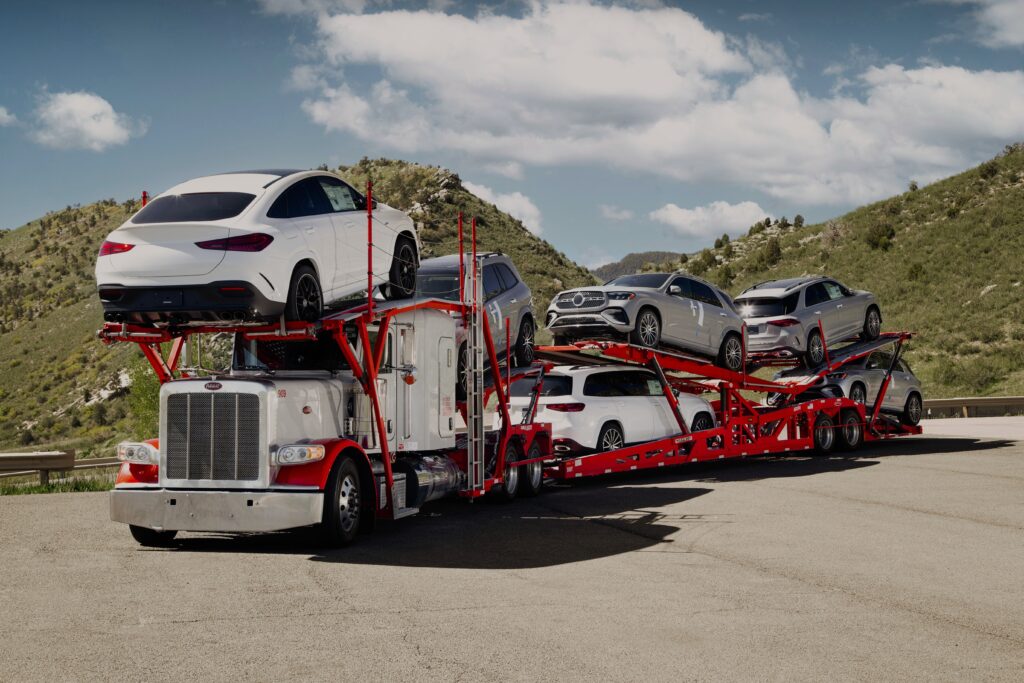
Our rigs are pulled by Peterbilt, Western Star, Volvo and Freightliner tractors and carry up to nine cars. We contract with our drivers, and you get a $5,000 sign-on bonus, paid in your first month. We ask for 3 years of CDL-A driving and 1 year of verifiable 9-car experience.
See the rigs we run, or read about driving for Accelerated.
Bridge Formula FAQs
What is the federal bridge formula?
It is the federal rule that limits the weight on any group of two or more axles on the Interstate, based on how many axles are in the group and how far apart they are. It is W = 500(LN/(N minus 1) + 12N + 36), in 23 CFR 658.17(e).
Does the bridge formula apply off the Interstate?
The federal formula covers the Interstate System and reasonable access to it. On other roads, state limits apply, and the CDL manual says states often set axle weights with a bridge formula of their own.
What is the bridge formula table?
It is FHWA’s table of the weights the formula allows for each axle count and distance. Find L, the distance between the outer axles, down the side and N, the number of axles, across the top.
What is the 36-foot rule for tandems?
Two tandems in a row may carry 34,000 pounds each if the first and last axles of the two tandems are 36 feet or more apart. Without it, the formula would allow less on tandems spaced 36 to 38 feet apart.
Why can some states allow more than 80,000 pounds?
Grandfather rights. When the federal limits were adopted in 1956 and changed in 1975, states could keep higher limits they already had. States may also issue special permits for loads that cannot be divided.
Sources
Last checked September 28, 2026. This is a plain-language summary. FHWA notes that where its guide and the law differ, the statute and regulation take precedence.