For truck drivers
Updated September 28, 2026
Air brakes stop a truck with compressed air. An engine-driven compressor fills the air tanks. When you press the brake pedal, air flows to a brake chamber at each wheel and pushes the brakes on.
Parking and emergency braking work the other way around. Powerful springs put those brakes on, and air holds the springs back. Lose the air, and the springs set the brakes.
This guide covers how the system works, the in-cab check you do before you drive, the CDL air brake test and the air brake restriction. Every number comes from the Colorado Commercial Driver License Manual or the federal rules, and each one is listed in the sources.
How Air Brakes Work
The CDL manual says air brakes are really three systems in one truck. The service brakes work when you press the pedal. The parking brakes work from the parking brake control. The emergency brakes use parts of both to stop the truck if the brake system fails.
Here is the path the air takes on the service brakes.
- Air compressorDriven by the engine. It pumps air into the storage tanks.
- GovernorStops the pumping at about 125 psi (cut-out) and starts it again at about 100 psi (cut-in).
- Air tanksHold enough air to use the brakes several times, even if the compressor stops.
- Brake pedalAlso called the foot valve. Press harder and more air goes to the brakes.
- Brake chambersAir pushes a rod out of the chamber at each wheel.
- Slack adjuster and drumThe rod moves the slack adjuster, which twists the S-cam. The shoes press against the drum and slow the wheel.
A few more parts keep the system healthy:
- Air tank drains. Compressed air carries water and oil. Water can freeze and cause brake failure. If your tanks drain by hand, the manual says to drain them at the end of each day of driving.
- Safety valve. It protects the first tank from too much pressure and is usually set to open at 150 psi. If it lets air out, have a mechanic fix the fault.
- Alcohol evaporator. Some systems add alcohol to the air to fight ice in cold weather. Check and fill it every day when it is cold.
- Foundation brakes. The S-cam drum brake is the most common. Wedge brakes and disc brakes work on the same air, with different parts at the wheel.
Gauges and the Low-Air Warning
Every truck with air brakes has a supply pressure gauge that shows the air in the tanks. A dual system has two gauges, or one gauge with two needles. Some trucks also have an application gauge. If you need more and more pressure to hold the same speed, your brakes are fading.
The warning is a federal rule. Under 49 CFR 393.51, a truck with air brakes must warn you whenever the air is at 55 psi or below, or at half the governor cut-out pressure, whichever is less. The warning is usually a red light and may add a buzzer. Some trucks drop a mechanical arm, called a wig wag, into your view.
Dual Air Systems and Spring Brakes
Most heavy trucks use a dual air brake system. It is two separate air systems run by one set of controls. One usually works the rear brakes. The other works the front brakes, and maybe one rear axle. Both feed the trailer.
Before you drive a truck with a dual system, let the compressor build at least 100 psi in both the primary and the secondary system. If one system runs very low, either the front or the rear brakes will not work fully, and you will need longer to stop.
Spring Brakes
Parking and emergency brakes must be held on by mechanical force, because air can leak away. Spring brakes do this job. While you drive, air holds strong springs back. Take the air away and the springs put the brakes on.
- They come on by themselves. On tractors and straight trucks, spring brakes come fully on when air drops to a range of 20 to 45 psi, typically 20 to 30 psi.
- Do not wait for them. The manual says to bring the truck to a safe stop right away when the low-air warning first comes on, while you can still control the brakes.
- The yellow knob sets them. On newer trucks, pull the yellow, diamond-shaped knob out to set the parking brakes and push it in to release them.
- Keep off the pedal when they are set. Pushing the brake pedal with the spring brakes on can damage the brakes.
On a tractor-trailer, the tractor protection valve closes on its own if the air supply drops, so the tractor keeps its brakes if the trailer breaks away. Federal rules say it must work automatically when the tractor’s air is between 20 and 45 psi (49 CFR 393.43).
The In-Cab Air Brake Check
This is the check you do before you drive. It shows the air system holds pressure, warns you in time, and sets the brakes when air runs out. The steps below follow the manual’s final air brake check (section 5.3.3). Your truck maker’s numbers come first where they differ.
In-cab air brake check
- 125 / 100Governor cut-out and cut-in. Run the engine at a fast idle. Pumping should stop at about 125 psi. Pump the brake to drop the pressure, and pumping should start again at about 100 psi.
- 3 / 4 psiLeakage rate. With air built up to cut-out (120 to 140 psi), shut the engine off. Chock the wheels if needed, release the parking brake and the tractor protection valve, and hold the brake pedal down. After the gauges settle, time one minute. More than 3 psi lost on a single vehicle, or 4 psi on a combination, is too much.
- 55 psiLow-air warning. Turn the power on and pump the pedal to lower the air. The warning must come on before the tank pressure drops below 55 psi.
- 20-45 psiSpring brakes come on. Keep fanning off air. The parking brake valve should pop out between 20 and 45 psi, and on a tractor-trailer the tractor protection valve too.
- 45 secBuild-up rate. With the engine at operating RPM, a dual system should build from 85 to 100 psi within 45 seconds. Bigger tanks can take longer and still be safe.
- HoldParking brake. Set it and pull gently against it in a low gear. It should hold.
- 5 mphService brakes. Roll forward slowly and brake firmly. Watch for pulling to one side, an odd feel or a slow stop.
Colorado Commercial Driver License Manual, 5.3.3, Final Air Brake Check
If the air does not build fast enough, or it leaks too fast, do not drive until it is fixed. The manual says a leak like that could leave you without brakes on the road.
On the CDL test. The air brake check is part of the in-cab inspection, and getting it wrong means an automatic fail of the vehicle inspection test. The manual’s section 11 lists three parts: leakage, the low-air warning and the spring brakes. Its newer test section, 11M, lists four, adding the gauge and governor cut-out check first. You are expected to know the maker’s numbers for the truck you test in. For the rest of the inspection, see our pre-trip inspection checklist.
The Air Brake Test for Your CDL
There are two parts. The first is a knowledge test. The CDL manual says you must take the Air Brakes Test if your vehicle has air brakes, including air over hydraulic brakes. Study section 5 of your state’s manual, and section 6 too if you will pull a trailer. Federal rules set the passing score at 80% (49 CFR 383.135).
The second part happens on the skills test, during your pre-trip inspection. Federal rules list six air brake skills you must show (49 CFR 383.113):
- Find and name the air brake controls and gauges.
- Check that the brakes are adjusted and that air lines between tractor and trailer are hooked up and secure.
- Check that the low-pressure warning will come on in an emergency.
- With the engine running, make sure the system keeps enough air.
- Check that air builds within the allowed time, and that alarms and emergency devices shut off at the right pressure.
- Test that the brakes work.
Already run air-braked rigs, with 3 years of CDL-A driving and 1 year of verifiable 9-car experience? Apply to contract with Accelerated.
The Air Brake Restriction
People search for an “air brake endorsement,” but the federal rules have no such endorsement. What they have is a restriction. Here is how it lands on your license:
LNo air brakes
You failed or skipped the air brake knowledge test, or took the skills test in a truck without air brakes. You may not drive a commercial vehicle with any type of air brakes.
ZNo full air brakes
You took the skills test in a truck with air over hydraulic brakes. You may not drive a commercial vehicle with brakes that work fully on air.
Taking the restriction off. You do not have to retake the whole skills test. Under 49 CFR 383.135, your state may give a shorter skills test in a truck with the brakes you want. To remove L or Z, you must also do the air brake pre-trip inspection and pass the air brake knowledge test. Ask your state licensing office how it runs this. Other restriction codes are covered in our guide to CDL endorsements.
Using Air Brakes on the Road
Air brakes do not work the instant you press the pedal. The air takes time to reach the wheels. The manual calls this brake lag: a half second or more. At 55 mph on dry pavement, it adds about 32 feet to your stopping distance.
- Normal stops. Press the pedal and control the pressure for a smooth stop. With a manual transmission, keep the clutch out until the engine is near idle.
- Emergency stops. The manual gives two methods. Controlled braking: brake as hard as you can without locking the wheels, with small steering moves. Stab braking: brake fully, release when the wheels lock, and brake fully again once they roll.
- ABS. Tractors with air brakes built on or after March 1, 1997, must have anti-lock brakes. Brake the way you always do. ABS keeps the wheels from locking, and a yellow lamp tells you if it is not working.
- Low air. If the warning comes on, stop and park as soon as it is safe. The spring brakes do not work on every axle, so a heavy truck needs a long way to stop on them alone.
- Parking. Use the parking brakes whenever you park, except when the brakes are very hot or very wet in freezing weather. Then chock the wheels on level ground.
Long downgrades are where air brakes get pushed hardest. The manual says brakes on a long or steep grade are only a supplement to the engine’s braking effect. See our guide to jake brakes and mountain driving for the braking method and brake fade.
Run Air-Braked Rigs With Accelerated
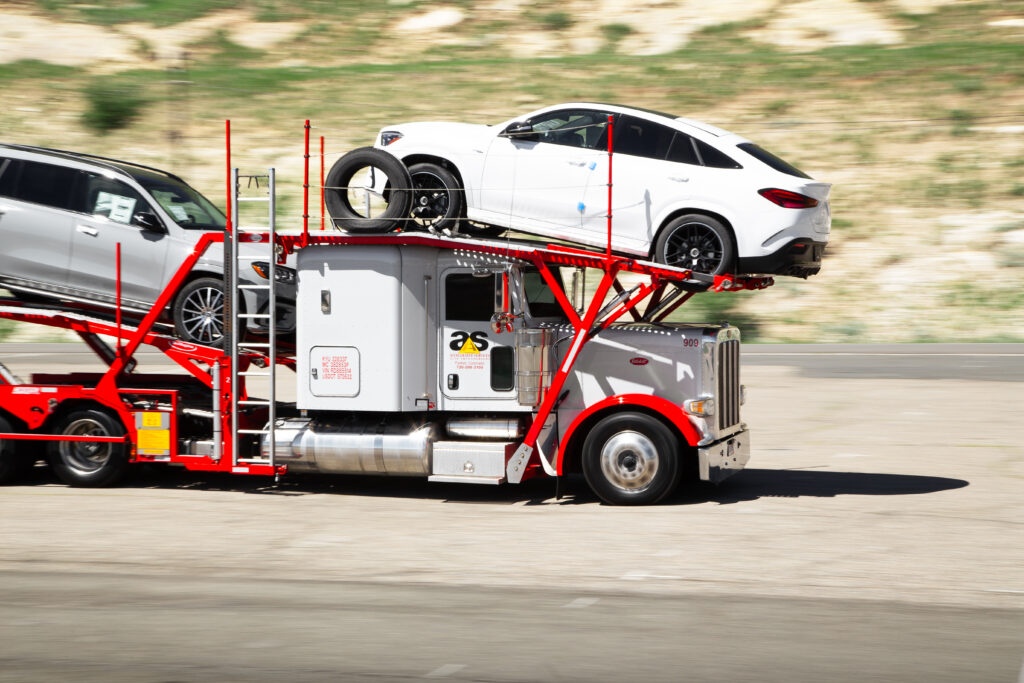
Our car haulers are pulled by Peterbilt, Western Star, Volvo and Freightliner tractors and carry up to nine cars. We contract with our drivers, and you get a $5,000 sign-on bonus, paid in your first month. We ask for 3 years of CDL-A driving and 1 year of verifiable 9-car experience.
Want to see the trucks first? Look through the rigs we run.
Air Brake FAQs
What psi should truck air brakes be?
The CDL manual says the governor usually stops the compressor at about 125 psi and starts it again at about 100 psi. The low-air warning must come on before the tanks fall below 55 psi. Check your truck maker’s numbers, because they come first.
What happens if a truck loses air pressure?
The low-air warning comes on first. If the air keeps dropping, the spring brakes come on between 20 and 45 psi. The manual says to stop safely as soon as the warning comes on, while you still have control of the service brakes.
What is an air brake endorsement?
There is no federal air brake endorsement. If you fail or skip the air brake knowledge test, or test in a truck without air brakes, your license gets an L restriction. Removing it takes the air brake knowledge test, the air brake pre-trip inspection and a skills test in an air-braked truck.
How long does it take to build air pressure?
In a dual air system, the manual says pressure should build from 85 to 100 psi within 45 seconds with the engine at operating RPM. Trucks with larger tanks can take longer and still be safe, so check the maker’s numbers.
What is a brake chamber?
It is the part at each wheel that turns air into force. When you press the pedal, air fills the chamber and pushes out a rod. The rod moves the slack adjuster, which twists the S-cam and presses the brake shoes against the drum.
Sources
Last checked September 28, 2026. This guide explains the manual and the federal rules in plain words. Your truck maker’s specifications and your state’s CDL manual come first.
- Colorado Commercial Driver License Manual, June 2023 (PDF): 1.1.1 Knowledge Tests, restriction codes, Section 5 Air Brakes, Section 11 and 11M Vehicle Inspection
- 49 CFR 393.51, Warning signals, air pressure and vacuum gauges
- 49 CFR 393.43, Breakaway and emergency braking
- 49 CFR 393.41, Parking brake system
- 49 CFR 383.113, Required skills
- 49 CFR 383.135, Passing knowledge and skills tests
- 49 CFR 383.95, Restrictions
- 49 CFR 383.153, Information on the CLP and CDL documents