For truck drivers
Updated September 28, 2026
A jake brake is an engine brake on a heavy truck. It changes how the engine’s exhaust valves work, so the engine itself helps slow the truck.
On a long mountain grade, that matters. The Colorado CDL manual says the engine’s braking effect should be your main way to control speed going down. That saves your service brakes, so they can still slow or stop you when traffic and the road demand it.
This guide takes a loaded truck down a mountain grade, start to finish. The methods come from the Colorado Commercial Driver License Manual and the Colorado Department of Transportation (CDOT). Driving a pickup with an exhaust brake? Check your engine maker’s guide. This page is about heavy trucks.
What Is a Jake Brake?
“Jake Brake” is a registered trademark of Jacobs Vehicle Systems. That is where the name comes from. Drivers use it for any engine compression release brake, whoever made it.
The CDL manual calls these devices retarders. It says a retarder:
- Helps slow the vehicle, so you use your brakes less
- Cuts brake wear and gives you another way to slow down
- Slows the drive wheels only, not every wheel
- Can be turned on or off by the driver, and on some trucks the strength can be adjusted
A retarder is not built to bring the truck to a full stop. It holds your speed back. Your service brakes still do the stopping.
How a Jake Brake Works
An engine brake changes how the engine’s exhaust valves open. Air the engine has squeezed is let out through the exhaust, and that slows the truck. Many are switched on when you let off the accelerator. Some work from a separate control or the brake pedal.
Here is what that means in the cab:
- It works when you are off the throttle. The manual says a retarder that is on applies its braking power whenever you let up on the accelerator all the way.
- It is strongest in a low gear. The engine’s braking effect is greatest near governed RPM with the transmission in the lower gears.
- It can make you skid. On a wet, icy or snowy road, the drive wheels can lose grip. The manual says to turn the retarder off when the road is slick.
Winter note: the manual’s winter section says not to use the engine brake or speed retarder on slippery roads. Winter grades in Colorado can also bring chain law. See our guide to the Colorado chain law for truckers.
Jake Brake vs Engine Brake vs Exhaust Brake
The names get mixed up. The CDL manual lists four types of retarder: exhaust, engine, hydraulic and electric. Here is how the common terms line up.
| Term | What it means |
|---|---|
| Jake brake | A Jacobs trademark. Drivers use it for any engine compression release brake. |
| Engine brake | A retarder inside the engine. It changes how the exhaust valves open so the engine slows the truck. |
| Exhaust brake | A separate type of retarder in the manual’s list. It is not the same device as an engine brake. |
| Hydraulic or electric retarder | The other two types the manual names. They also slow the drive wheels only. |
Whatever the type, the rules below are the same. Know how your truck’s retarder works, and never count on it to stop you.

Brake Fade and Why Long Grades Are Dangerous
Going down a long grade, gravity keeps adding speed. If you hold the truck back with the service brakes alone, they heat up. Then they start to fade.
The manual explains fade this way. You have to press harder and harder to get the same stopping power. Keep braking hard and they can fade until you cannot slow down or stop at all.
Two things set up a fade:
- Too much braking. Brakes fail from heat when you use them too much and do not rely on the engine.
- Brakes out of adjustment. Those brakes stop doing their share. The rest overheat and fade. Brakes can go out of adjustment fast when they are used a lot, so check them often.
CDOT’s hot-brakes guide lists the warning signs: a burning smell, squealing, smoke, a soft brake pedal and less stopping power.
How to Take a Mountain Grade
Every step below comes from the CDL manual (section 2.16) or CDOT’s hot-brakes guide.
- Know the grade before you get there. Find out about long, steep grades on your route. If you can, ask drivers who know them what speeds are safe.
- Check your brakes at the top. CDOT asks every driver to do an extra inspection before Colorado’s steep grades. CDOT lists brake check areas around the state.
- Pick a safe speed. Base it on your total weight, the length and steepness of the grade, the road and the weather. Never go over a posted speed limit or a “Maximum Safe Speed” sign.
- Pick your gear before the descent. Shift down before you start down, not after. Once speed builds, you may not get into a lower gear, or back into any gear.
- Let the engine hold you back. The engine’s braking effect is your main tool. The manual calls the brakes “only a supplement” on a long or steep downgrade.
- Brake in short, firm steps. Use the method in the card below, and repeat it to the bottom.
The manual’s braking method
Safe speed 40 mph: brake to 35, let off, repeat
- 40Your speed reaches your safe speed. Apply the brakes just hard enough to feel a definite slowdown.
- 35At about 5 mph below safe speed, release the brakes. That application lasts about three seconds.
- 40Speed builds back to your safe speed. Repeat steps 1 and 2 until the end of the downgrade.
Colorado Commercial Driver License Manual, 2.16.4, Proper Braking Technique
Which gear? CDOT’s guide says to go down steep hills in the same gear you climbed them in. The manual adds a warning. Modern trucks have less friction and drag, so you may need a lower gear going down than going up. Know what is right for your truck.
Runaway Truck Ramps
A runaway truck ramp, also called an escape ramp, is a lane off the highway that stops a truck with no brakes. It uses a long bed of loose, soft gravel. Some ramps also turn uphill.
The manual is plain about it. If your brakes fail on a downgrade, your best hope is an escape ramp. If there is one, use it. Signs tell you where they are, and ramps usually sit a few miles from the top of the grade.
If there is no ramp, take the least dangerous way out you can, such as an open field or a side road that flattens out or turns uphill. Do it as soon as you know the brakes are gone. The longer you wait, the faster you go.
If a ramp is your way out
CDOT’s guide gives five steps:
- Turn on your hazards.
- Get in the right lane.
- Enter the truck ramp straight on.
- Let the truck come to a complete stop on its own.
- Call 911 to report it.
Do not use a highway exit instead of the ramp, CDOT says. Its guide adds that you may owe a tow bill, but CDOT and the State Patrol will not ticket you for using a ramp. You can be cited if you cause a crash because you did not use one.
Runaway truck ramps on I-70 in Colorado
| Mile post | Name in the CDOT guide |
|---|---|
| MP 182Westbound | Upper Vail |
| MP 186Westbound | Lower Vail |
| MP 209Westbound | Lower Straight Creek |
| MP 212Westbound | Upper Straight Creek |
| MP 257Eastbound | Mount Vernon Canyon Rebuilt 2024 |
CDOT rebuilt the eastbound Mount Vernon ramp, just east of Genesee, and opened it on June 2, 2024. Its guide also lists ramps on other Colorado highways, including US 40, US 50, US 160 and US 550. Before you go, check road conditions on COtrip.
Running the Rockies already? Haul new vehicles out of our Denver home base.

“No Engine Brake” Signs and Noise Rules
Engine brakes can be loud. That is why you see signs coming into some towns. Most of these rules are local. A city or county passes a noise rule, and the sign on the road tells you it is there.
In Colorado, CDOT lets counties and cities post engine brake signs on state highways, under set conditions:
- The local police must commit to enforcing the rule.
- Signs are not allowed on freeways or interstates.
- CDOT prefers them at the city limit or county line.
- The standard sign reads “Truckers Engine Brake Mufflers Required.” A version near the state line also lists a $500 fine.
There is a federal noise rule too. It caps how loud a motor carrier’s truck can be on the highway, measured in decibels at a set distance (49 CFR 325.7). A 2004 Connecticut legislative report notes that engine brake noise is part of exhaust noise and can be controlled with a working muffler.
The CDL manual’s advice is short: retarders can be noisy, so be sure you know where their use is allowed.
Mountain Freight Out of Denver
Denver is Accelerated’s home base. Our operational yard sits in nearby Parker, Colorado. From here, drivers run rail-head and regional lanes across the Rocky Mountain region, moving new vehicles for the automakers, the same work Motor Car Auto Carriers did before it became part of Accelerated.
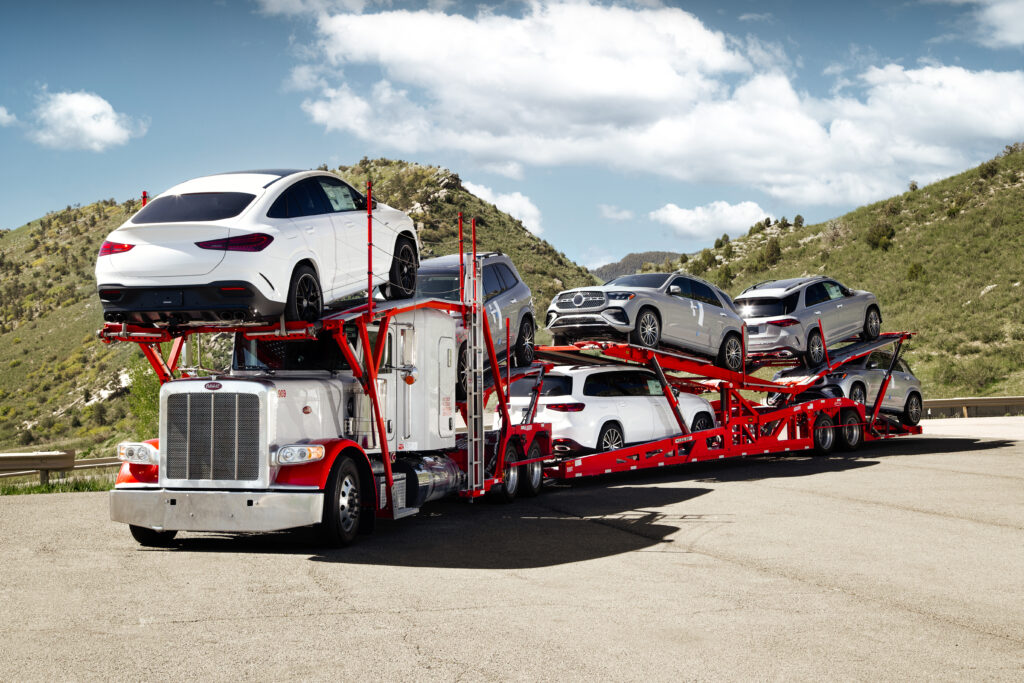
A loaded car hauler on a mountain grade is exactly where everything on this page counts. Our rigs are pulled by Peterbilt, Western Star, Volvo and Freightliner tractors and carry up to nine cars. See the rigs we run. Winter adds chains to the job. Our guide to chain laws by state covers the western states.
Haul Cars Out of Denver
We have hauled finished vehicles for the automakers since 1999, and we contract with our drivers. We ask for 3 years of CDL-A driving and 1 year of verifiable 9-car experience. See our Denver terminal, or start your application now.
The application takes a few minutes from your phone.
Jake Brake and Mountain Driving FAQs
What is a jake brake?
It is an engine compression release brake. It changes how the exhaust valves work so the engine slows the truck. “Jake Brake” is a Jacobs Vehicle Systems trademark, but drivers use the name for any engine brake.
Why is it called a jake brake?
The name comes from Jacobs Vehicle Systems, which holds “Jake Brake” as a registered trademark. The word stuck, so drivers say jake brake for engine brakes from other makers too.
What does a runaway truck ramp do?
It stops a truck that has lost its brakes on a downgrade. The ramp uses a long bed of loose, soft gravel, and some ramps also turn uphill. The CDL manual says to use one if your brakes fail and a ramp is there.
When should you not use a jake brake?
On a wet, icy or snowy road, the CDL manual says to turn the retarder off, because it can make the drive wheels skid. Also follow any local sign or rule that limits engine brake use.
What gear should a truck use going down a mountain?
A low gear chosen before you start down. The CDL manual says modern trucks may need a lower gear going down than going up. CDOT’s guide says to go down in the same gear you climbed in.
Sources
Last checked September 28, 2026. Ramp locations and sign rules can change. Follow the signs on the road and your truck maker’s guide for your retarder.
- Colorado Commercial Driver License Manual, June 2023 (PDF): 2.3.4 Retarders, 2.13 Driving in Winter, 2.16 Mountain Driving, 2.17 Driving Emergencies
- CDOT, Hot Brakes and Runaway Truck Ramps of Colorado (PDF)
- CDOT, eastbound I-70 Mount Vernon emergency escape ramp opens, June 2, 2024
- CDOT Freight, The Mountain Rules
- CDOT, Engine Brake/Noise Ordinance Sign Guidance, 2025 edition (PDF)
- Connecticut Office of Legislative Research, Jake Brakes, report 2004-R-0741
- 49 CFR 325.7, Allowable noise levels