
For owner-operators and drivers
Updated September 27, 2026
For truck drivers, “per diem” usually means the IRS’s special daily meal rate for the transportation industry. It is $80 a day for travel in the continental United States and $86 a day outside it. IRS Notice 2026-60 keeps those rates for travel on or after October 1, 2026.
Drivers under the DOT’s hours-of-service rules can also deduct 80% of their meal costs, not the usual 50%. This guide explains the IRS rules. It is general information, not tax advice.
Tax rules turn on your own situation, so take your numbers to a tax professional. What follows is what the IRS says, with the source for each rule, so you know what to ask.
What Per Diem Means for Truckers
When you are on the road overnight, you buy meals. The IRS gives you two ways to count those costs:
- Actual cost: keep every meal receipt and add them up.
- Standard meal allowance: use a set daily amount instead of adding up receipts. The IRS calls it the rate for meals and incidental expenses.
For most travelers, the standard rate changes with each city where you stop to sleep. That would be a headache for a trucker who sleeps in a different place every night. So the IRS offers a special rate for transportation workers. One rate covers every stop in the continental United States.
Travel October 1, 2025 to September 30, 2026
$80a day in the continental U.S.
$86 a day outside the continental U.S.
IRS Notice 2025-54
Travel on or after October 1, 2026
$80a day in the continental U.S.
$86 a day outside the continental U.S.
IRS Notice 2026-60. Same rates as the year before.
The IRS sets these rates on the federal fiscal year, which starts October 1, and publishes them in an annual notice.
Who Can Use the Transportation Rate
IRS Publication 463 says you are in the transportation industry if your work:
- Directly involves moving people or goods by truck (or by plane, barge, bus, ship, or train), and
- Regularly takes you away from home, and on a single trip usually takes you to areas with different meal rates.
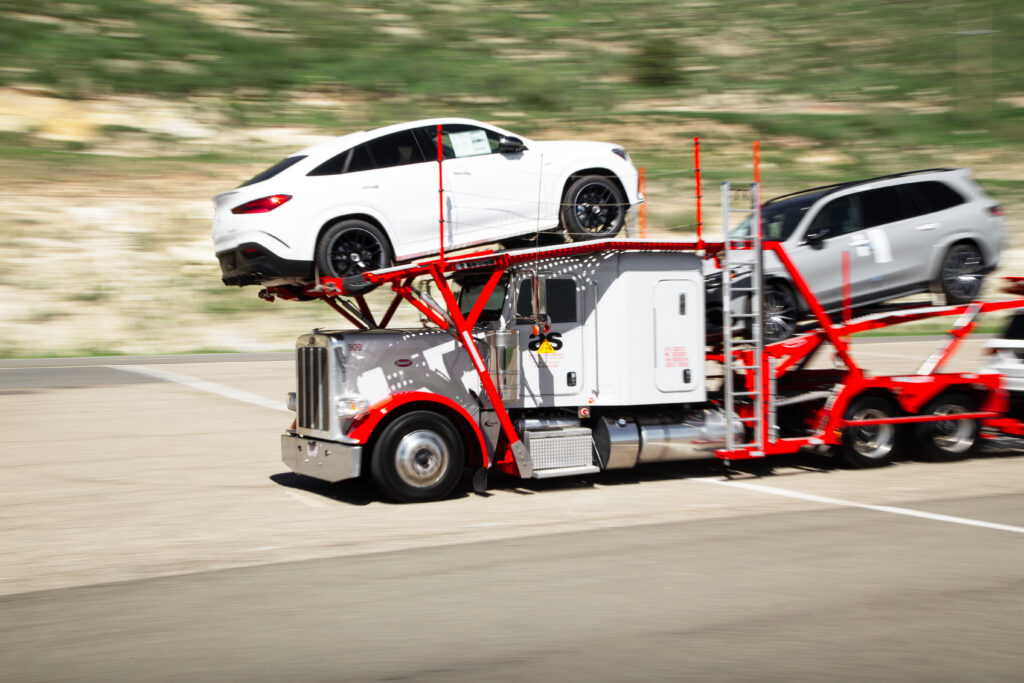
Hauling vehicles by truck meets the first test. The second depends on your runs. You also have to be “away from home” in the tax sense. That means two things. Your work keeps you away from your tax home much longer than a normal workday, and you need to stop for sleep or rest to do the job.
The IRS gives a truck driver example. You leave your terminal and come back the same day, with an hour off to eat. That is not travel away from home, because the short break is not time for real rest. Napping in your vehicle does not count as rest either, the IRS says.
The 80% Rule for Hours-of-Service Drivers
Most people can deduct only 50% of business meal costs. Truck drivers can often deduct more.
Publication 463 sets the share at 80% for meals tied to work under the DOT’s hours-of-service limits. The meals must be eaten while you are away from your tax home. The IRS lists interstate truck drivers under DOT rules as one group this covers.
If you drive under the federal hours-of-service rules, this is the part to raise with your tax professional. Our guide to hours of service for car haulers covers those rules.
Full Days and Partial Days
You do not get the full daily rate on the day you leave or the day you come home. Publication 463 gives two ways to handle those partial days:
- Use 3/4 of the daily rate, or
- Use any other method you apply the same way every time, as long as it follows normal business practice.
A worked example of the math. Say you leave Monday and get home Friday, and every night is spent away in the continental U.S. Using the 3/4 method at $80:
| Day | Rate used | Amount |
|---|---|---|
| Monday, you leave | 3/4 of $80 | $60 |
| Tuesday | Full day | $80 |
| Wednesday | Full day | $80 |
| Thursday | Full day | $80 |
| Friday, you return | 3/4 of $80 | $60 |
| Trip meal amount | $360 | |
| At 80% | $288 | |
This only shows how the IRS figures fit together. Your actual deduction depends on your tax situation, so check it with a professional.
Spend your nights on the road hauling new vehicles. Contract with Accelerated.
Records to Keep
The standard rate saves you from saving every meal receipt. It does not save you from keeping records. Publication 463 says you must still be able to prove:
- Time: the dates you left and came back, and the days you were away
- Place: where you traveled
- Business purpose: why the trip was for work
One more rule: if you use the special transportation rate for any trip, you must use it for all of your trips that year. You cannot switch back and forth to the city rates.
If you run your own authority, the trip records you keep for fuel tax overlap with these. See our guide to IFTA and IRP for owner-operators.
Employee or Contractor?
Publication 463 says you can use the standard meal allowance whether you are an employee or self-employed. How it lands on your tax return is different for each.
- If you are an employee, the rules depend on whether and how your employer pays you for travel costs. The IRS explains those rules in chapter 6 of Publication 463.
- If you are self-employed, you run a business, and your travel costs are part of your business records.
Accelerated contracts with its drivers. We do not hire them as employees. How per diem applies to you as a contract driver is a question for your tax professional.
Weighing whether to drive for a carrier or run your own truck? See how to become an owner-operator.
Haul New Vehicles With Accelerated
We have hauled finished vehicles for the automakers since 1999. We ask for 3 years of CDL-A driving and 1 year of verifiable 9-car experience. See car hauler jobs at Accelerated, or start your application now.
The application takes a few minutes from your phone.
Truck Driver Per Diem FAQs
What is the per diem rate for truck drivers?
The IRS special rate for the transportation industry is $80 a day in the continental United States and $86 a day outside it. IRS Notice 2026-60 sets those rates for travel on or after October 1, 2026, the same as Notice 2025-54 for the year before.
Is per diem 80% or 50% for truck drivers?
IRS Publication 463 says drivers subject to the DOT’s hours-of-service limits can deduct 80% of meal costs while away from their tax home. Most other business meals are held to 50%.
Do I get the full rate on the day I leave or come home?
No. For the day you leave and the day you return, Publication 463 lets you claim 3/4 of the daily rate. Or you can use another method, if you apply it the same way every time.
Do I need receipts to claim per diem?
Not for each meal if you use the standard rate. But you still need records of the time, place, and business purpose of your travel, according to Publication 463.
Can a local driver who is home every night claim per diem?
Generally not. The IRS says a driver who leaves the terminal and returns the same day, without time off for real sleep or rest, is not traveling away from home.
Sources
Last checked September 27, 2026. The IRS updates these rates each fall and can change the rules. This guide is general information, not tax advice. For your own return, talk to a tax professional and read the IRS sources below.