For future truck drivers
Updated September 28, 2026
A Class A CDL lets you drive a combination of vehicles, like a tractor pulling a trailer, when the whole rig is rated at 26,001 pounds or more and the trailer is rated over 10,000 pounds. A Class B CDL covers one heavy vehicle, like a straight truck or a large bus.
A Class A holder may also drive Class B and Class C vehicles, with the right endorsements. Hauling cars takes a Class A.
This guide explains each CDL class in plain words, straight from the federal rules in 49 CFR 383.91. It shows what each class lets you drive, how the tests differ, and which license a car hauler needs.
The Three CDL Classes at a Glance
Federal rules sort commercial vehicles into three groups. Your state prints the group on your license as a letter: A, B or C. Each class is set by the weight rating the maker puts on the vehicle, not by how much it weighs on a given day.
Class A: Combination
A rig rated 26,001 lb or more, towing a unit rated over 10,000 lb
Tractor-trailers, truck and trailer combinations, car haulers
Also covers Class B and C, with the right endorsements
Class B: Heavy Straight
One vehicle rated 26,001 lb or more, towing 10,000 lb or less
Straight trucks and large buses
Also covers Class C, with the right endorsements
Class C: Small Vehicle
Neither A nor B, but carries 16 or more people or placarded hazardous materials
Small buses, and small trucks hauling placarded hazmat
Covers only Class C
What Is a Class A CDL?
The federal rule calls Class A a combination vehicle. A vehicle needs a Class A CDL when both of these are true:
- The gross combination weight rating (GCWR) is 26,001 pounds or more. That is the rating for the truck and everything it tows, added together.
- The vehicle being towed has a gross vehicle weight rating (GVWR) of more than 10,000 pounds.
The Colorado CDL manual, which follows the national model manual, says most Class A vehicles are trucks such as a tractor with a semi-trailer, or a truck and trailer combination. It adds that driving one takes considerably more skill and knowledge than driving a Class B or C vehicle.
That extra skill is why a Class A covers the other classes too. In the manual’s words: “a driver who has a Class A license also may drive vehicles in Classes B and C.” The federal rule adds the catch: you still need any endorsement the other vehicle calls for, such as passenger or school bus.
What Is a Class B CDL?
Class B is a heavy straight vehicle. That means one vehicle with a GVWR of 26,001 pounds or more. It can tow a trailer, but only one rated at 10,000 pounds or less.
The Colorado manual lists straight trucks and large buses, including articulated buses, as Class B. A Class B holder may also drive Class C vehicles, with the right endorsements.
What a Class B does not cover: any tractor-trailer or other combination where the towed unit is rated over 10,000 pounds. For that, you need a Class A.
Class A vs Class B CDL, Side by Side
Here is the difference between a Class A and a Class B CDL in one place.
| Question | Class A | Class B |
|---|---|---|
| What you can drive | Combinations rated 26,001 lb or more, towing a unit rated over 10,000 lb | One vehicle rated 26,001 lb or more, towing 10,000 lb or less |
| Typical vehicles | Tractor-trailers, car haulers, truck and trailer rigs | Straight trucks, large buses |
| Extra knowledge test | Combination vehicles test | None beyond general knowledge |
| Skills test vehicle | A Class A combination | A Class B vehicle |
| Other classes covered | B and C, with endorsements | C, with endorsements |
| Entry-level training | Required the first time | Required the first time |
Both classes start at the same 26,001 pound line. The real split is the trailer. Once you tow a unit rated over 10,000 pounds, you are in Class A.
What About a Class C CDL?
Class C is for smaller vehicles that still need a CDL because of what they carry. A vehicle is Class C when it is not Class A or B, and it either:
- Is designed to carry 16 or more people, counting the driver, or
- Carries hazardous materials in amounts that require placards, or certain select agents and toxins.
The Colorado manual notes that the Class C category depends mainly on the cargo, not the size. Some states also add more vehicles to their CDL rules, such as buses built for fewer than 16 people. Check your state’s manual.
How the Class A and Class B Tests Differ
Every CDL applicant takes the general knowledge test. A Class A applicant also takes the combination vehicles test. You need at least 80% on each knowledge test to pass. If you fail the combination test, federal rules say the state must not give you a Class A permit or license.
If your truck has air brakes, you also take the air brakes test. If you skip or fail it, your permit or license gets a restriction that bars you from driving any vehicle with air brakes. To see every test in order, read our guide to the CDL permit test.
The skills test must be taken in a vehicle that fits the class you want. The state looks at the vehicle’s weight rating, not how loaded it is that day. Your test vehicle can also add restrictions:
- Test in a truck with an automatic transmission, and your CDL bars you from driving a manual.
- Test for Class A in a rig hooked up with a pintle hook instead of a fifth wheel, and your CDL bars you from tractor-trailers with a fifth wheel.
Our guide to the CDL skills test covers all three parts. Before either skills test, first-time Class A and Class B applicants must finish entry-level driver training with a provider on FMCSA’s registry. The same applies when you upgrade to a Class A.
Already hold a Class A and years of car-haul miles? Contract with Accelerated.
Which CDL Do Car Haulers Need?
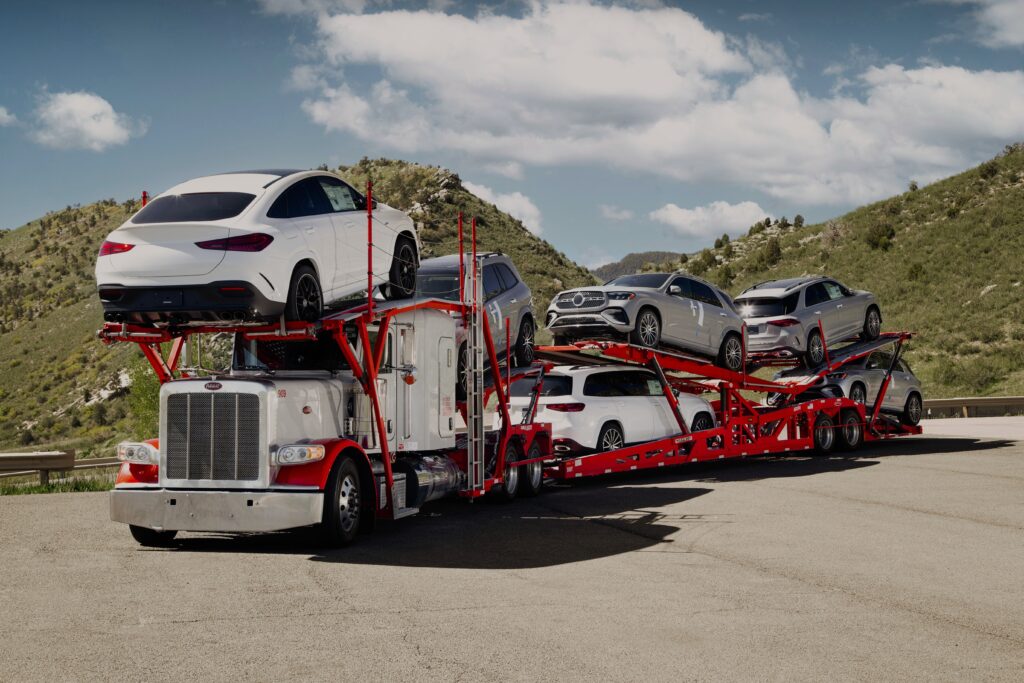
A car hauler is a tractor pulling a trailer, with cars loaded on both. Accelerated’s rigs carry up to nine cars. A loaded rig like that is far over the 26,001 pound line, and the trailer is rated well over 10,000 pounds. So hauling cars takes a Class A CDL.
A Class A is only the start, though. Loading and securing up to nine vehicles is a specialty. Before you can contract with us, Accelerated asks for:
You also need a valid Class A CDL, an acceptable MVR, a clean safety history and a current DOT medical card. If you are not there yet, most drivers build their Class A miles with other freight first. Our no-experience FAQ lays out the honest path in, and our guide to how long it takes to get a CDL walks through each step.
Class A vs Class B CDL FAQs
Can a Class A CDL driver drive a Class B truck?
Yes. Federal rules say a driver who passed the Class A tests may drive Class B and Class C vehicles, as long as the driver has any endorsement those vehicles need, such as passenger or school bus.
Do I need a Class B before I get a Class A?
No. You can train and test for a Class A from the start. Federal entry-level training rules cover anyone getting a Class A for the first time, as well as drivers who upgrade from a Class B.
Is a Class A CDL harder to get than a Class B?
It takes one more knowledge test, the combination vehicles test, and a skills test in a tractor-trailer or other combination. The Colorado CDL manual says a Class A vehicle takes considerably more skill and knowledge to drive than a Class B or C.
What do the letters on a CDL mean?
The class letter shows the group you may drive: A for combination, B for heavy straight vehicle and C for small vehicle. Other letters show endorsements, like T for doubles and triples or N for tank, and restrictions, like E for no manual transmission.
What CDL do you need to haul cars?
A Class A. A car hauler is a tractor pulling a loaded trailer, which puts it in the combination class. Accelerated also asks for 3 years of CDL-A driving and 1 year of verifiable 9-car experience.
Ready to Put Your Class A to Work?
If you have 3 years of CDL-A driving and 1 year of verifiable 9-car experience, Accelerated wants to talk. Contract drivers get a $5,000 sign-on bonus, paid within the first month of activation. See the full requirements on our careers page.
Sources
Last checked September 28, 2026. States can add their own rules. Check with your state’s licensing agency before you start. This guide is a plain-language summary, not legal advice.
- 49 CFR 383.91, commercial motor vehicle groups
- 49 CFR 383.93, endorsements
- 49 CFR 383.95, restrictions
- 49 CFR 383.133, test methods
- 49 CFR 383.135, passing scores
- 49 CFR 383.153, what a CDL shows
- 49 CFR 380.609, entry-level driver training
- FMCSA, CDL drivers page (classes, endorsements, restrictions)
- Colorado DMV, Commercial Driver License Manual DR 2251 (June 2023), section 1