For CDL students
Updated September 28, 2026
The CDL skills test has three parts, always in this order: the pre-trip vehicle inspection, basic vehicle control, and the road test. You must pass each part before you move on to the next one.
You take it in the kind of truck you plan to drive, in English, with no interpreter. Federal rules say you can take it no sooner than 14 days after your learner’s permit is first issued.
This guide walks through test day in order: what the examiner asks you to show, how each part is scored, and what makes you fail. It uses the federal rules and the national model CDL manual, as Colorado publishes it.
1
Pre-trip inspection
Name, point to and explain each safety part, plus the air brake checks
2
Basic vehicle control
Backing and control exercises inside a coned area
3
Road test
A set route in real traffic, with an examiner scoring you
Fail one part and the test stops there.
Before Test Day
Check these off before you book a skills test:
- Hold your CLP for 14 days. Federal rules bar the skills test in the first 14 days after your commercial learner’s permit is first issued.
- Finish entry-level training. First-time Class A and B drivers must train with a provider on FMCSA’s Training Provider Registry. Washington says it will not test you until your provider has entered your course completion.
- Bring the right truck. Your test vehicle must fit the class you want, judged by its weight rating, not its load that day. In Washington and Virginia, you bring the vehicle.
- Keep the truck clean of labels. Colorado’s manual says a vehicle with parts marked or labeled by anyone but the maker cannot be used.
For the full order of steps, see how long it takes to get a CDL and our guide to entry-level driver training.
Part 1: The Pre-Trip Vehicle Inspection
You show the examiner that you know whether the truck is safe to drive. Colorado’s manual says you walk around the vehicle, name and point to or touch each item, and explain what you are checking and why. Federal rules list the areas you must be able to inspect:
- Engine compartment
- Cab and engine start
- Steering
- Suspension
- Brakes
- Wheels
- Side of the vehicle
- Rear of the vehicle
- Tractor-trailer features, if you test in one
The air brake check
If your truck has air brakes, you also show that the system works. The classic version of the check in Colorado’s manual has three steps:
- Leak check. With the engine off and the foot brake held for one minute, the air should not drop more than 3 psi (single vehicle) or 4 psi (combination).
- Low-air warning. Fan the brake to bleed off air. The buzzer, light or flag should come on before the pressure falls below 55 psi.
- Valves pop out. Keep fanning. On a tractor-trailer, the tractor protection valve and parking brake valve should close between 20 and 45 psi.
The manual is blunt: fail to do all three steps correctly, and you fail the inspection test.
The newer version of the test, which Colorado’s manual calls section 11M, lets you use the checklist printed in the manual. You may check items off, but you cannot write anything else on it before the test. You inspect one axle, but you should be ready to do the same on any axle. For the routine you would run every day on the job, see our pre-trip inspection checklist.
Part 2: Basic Vehicle Control
This part shows you can control the truck and judge where it is. You back and maneuver inside an area marked with lines or cones. The national model manual has two versions, and your state picks which one you take:
Classic version
6 exercises
- Straight line backing
- Offset back, right
- Offset back, left
- Parallel park, driver side
- Parallel park, conventional
- Alley dock
Colorado manual, section 12
Modernized version
4 exercises
- Forward stop
- Straight-line backing
- Forward offset tracking
- Reverse offset backing
Colorado manual, section 12M
Colorado prints both versions in one manual. Alabama and Florida publish the modernized version as a supplement to their manuals. Ask your tester which version you will take.
How the exercises are scored
Encroachments
Each time any part of the truck touches or crosses a boundary line or cone, it counts as an error.
Pull-ups
Stopping and pulling forward to fix your position. The first ones are free, but too many count as errors.
Looks
Getting out to check your position. The number is capped, and you must set the brake and climb out with three points of contact.
Final position
End exactly where the examiner said. If you do not, you fail this part.
In the classic version, you get one look on straight line backing and up to two on the others. In the modernized version, you get one free look on straight-line backing and two on reverse offset backing. It also counts “back-ups” on the forward offset exercise.
Part 3: The Road Test
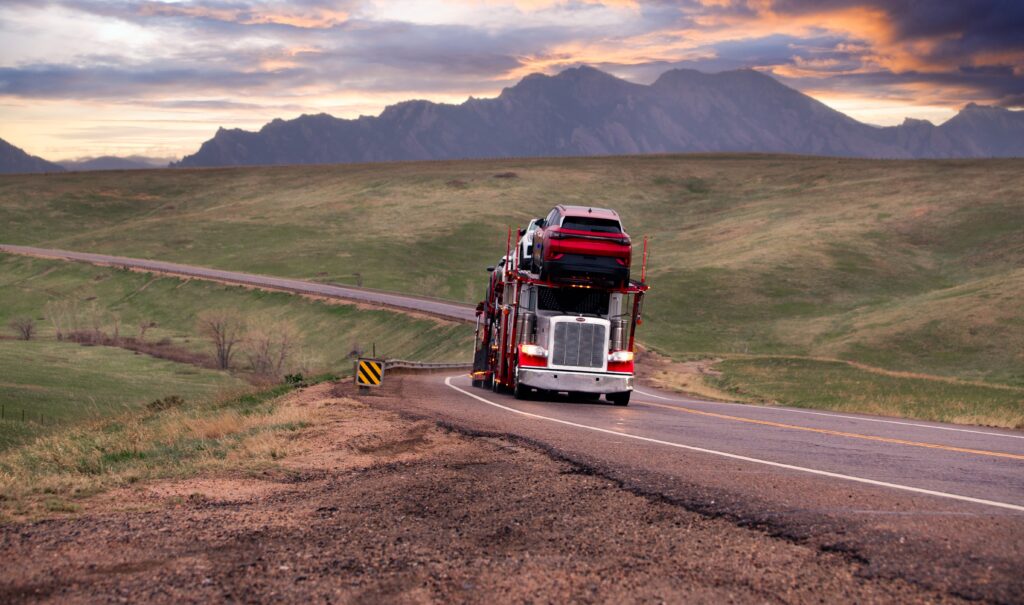
You drive a set route in real traffic while the examiner scores specific moves and your driving overall. The examiner tells you where to go and gives you time to do it. You must wear your seat belt, obey every sign and law, and finish without a crash or moving violation.
Colorado’s manual lists what the route can include:
- Left and right turns, and intersections
- City business streets and lane changes
- Getting on, driving and exiting an expressway
- A curve, and a pull-over stop and restart
- A railroad crossing
- A bridge or overpass, where you may be asked the posted height or weight limit
If the route has no railroad crossing or bridge, you may be asked to explain what you would do instead. With a manual transmission, the examiner also watches your clutch and gear use.
Passed the road test years ago, with car-haul miles since? Contract with Accelerated.
What Makes You Fail the CDL Skills Test
Federal rules say you automatically fail if you:
- Do not obey traffic laws
- Cause a crash during the test
- Commit any other offense the driver and examiner manuals list as an automatic fail
Colorado’s manual adds these: an “unsafe act,” like forgetting to set the parking brake or opening the door while moving; not following the examiner’s directions; and a missed or incorrect air brake check. To pass each part, you must show every required skill and reach the scores in the examiner’s manual.
If you fail one part, you stop there. Federal rules say the parts you passed count only while your first CLP is valid. If you renew your CLP, you retake all three parts.
Restrictions From Your Test Truck
The truck you test in shapes your license. Federal rules add a restriction when your test truck is missing something:
ETest with an automatic transmission, and you cannot drive a manual.
LTest without air brakes, and you cannot drive a truck with any air brakes.
ZTest with air over hydraulic brakes, and you cannot drive a truck with full air brakes.
OTest for Class A with a pintle hook, not a fifth wheel, and you cannot drive a fifth-wheel tractor-trailer.
FMCSA’s advice is simple: to avoid restrictions, test in the same type of truck you plan to drive. Removing E, L or Z later takes a shorter, modified skills test. Removing O means retaking all three parts in a tractor-trailer. For which class fits your truck, see Class A vs Class B CDL.
Third-Party CDL Testing
Many skills tests are not given by the state. Federal rules let a state approve a third-party tester, such as a school or a company, to give the skills test. The rules come with guardrails:
- A third-party tester gives the same test, instructions and score sheets the state would use.
- An examiner who also trained you cannot test you.
- The state checks each tester in person at least once every 2 years.
- The tester tells the state electronically when you pass.
How it works varies. Colorado gives skills tests at approved third-party testing facilities. Washington lets you test with its own examiner or a third-party examiner, and charges $175 for a truck skills test, covering two tries (checked September 28, 2026). Check your state’s CDL page for the list of approved testers.
After the CDL: The Carrier’s Road Test
Passing the state test is not the last time someone watches you drive. Carriers check new drivers too. At Accelerated, our driving test comes at orientation, not before you apply. By then you will already meet our bar: 3 years of CDL-A driving and 1 year of verifiable 9-car experience.
CDL Skills Test FAQs
How long does the CDL skills test take?
It varies by state. Washington says its test takes about 2 hours. Virginia says its 3-part skills test takes about 90 minutes.
What happens if you fail one part of the skills test?
The test stops, and you cannot go on to the next part. The parts you passed count only while your first learner’s permit is valid. If you renew the permit, you retake all three parts.
Can I take the CDL skills test in an automatic truck?
Yes, but your CDL will carry the E restriction, which bars you from driving a truck with a manual transmission. To remove it later, you take a modified skills test in a truck with a manual transmission.
Can my CDL school give me the skills test?
A school can be an approved third-party tester in many states. But federal rules bar an examiner from testing a student that same examiner trained.
Do I need my own truck for the CDL skills test?
You need to bring one that fits the class you want. Virginia and Washington both ask you to provide the vehicle. Washington asks for an owner’s letter if the truck is borrowed.
Years Past Your Skills Test?
Accelerated contracts with drivers who have 3 years of CDL-A driving and 1 year of verifiable 9-car experience. Contract drivers get a $5,000 sign-on bonus, paid within the first month of activation.
Just getting your CDL? Our no-experience FAQ shows the path in, and our careers page lists every requirement.
Sources
Last checked September 28, 2026. Test versions, fees and scheduling vary by state. Check with your state’s licensing agency or tester before test day. This guide is a plain-language summary, not legal advice.
- 49 CFR 383.113, required skills
- 49 CFR 383.133, test methods
- 49 CFR 383.135, passing scores
- 49 CFR 383.95, restrictions
- 49 CFR 383.75, third-party testing
- 49 CFR 383.25, commercial learner’s permit
- 49 CFR 380.609, entry-level driver training
- FMCSA, CDL drivers page (restrictions)
- Colorado DMV, CDL general information and manual DR 2251 (June 2023), sections 11 to 13, 11M and 12M
- Alabama ALEA, driver license manuals (modernized version supplement)
- Florida HSMV, handbooks and manuals
- Washington DOL, CDL skills test
- Virginia DMV, CDL skills tests