Starting a driving career
Updated September 28, 2026
To become a truck driver, meet the federal driver requirements, earn a commercial driver’s license (CDL), get hired, and build a driving record a carrier can verify. The Bureau of Labor Statistics says most tractor-trailer drivers attend a truck driving school first, and every one of them needs a CDL.
Each step below names the federal rule behind it, so you know what is required and what is up to each carrier.
This guide comes from a car-haul carrier that contracts with experienced drivers. We are not a first driving job, so this page is honest about where our own bar sits.
Step 1: Check the Driver Requirements
Federal rule 49 CFR 391.11 lists who may drive a commercial truck in interstate commerce. You must meet all seven:
- Age Be at least 21 years old.
- English Read and speak English well enough to talk with the public, read road signs, answer officials and fill out reports.
- Skill Be able to drive the type of truck you drive safely, through experience, training or both.
- Health Be physically qualified, which you show with a DOT medical certificate.
- License Hold one valid commercial license, from one state only.
- Record Not be disqualified from driving a commercial truck.
- Road test Pass the carrier’s road test, or show a license or certificate the carrier accepts in its place.
The Bureau of Labor Statistics adds that most companies want a high school diploma or the equivalent. Our DOT physical guide covers the medical exam, and our guide to CDL disqualifications explains what can keep you off the road.
Step 2: Choose Your License Class
A tractor-trailer takes a Class A CDL. Federal rules put a truck in that group when the combination is rated at 26,001 pounds or more and the trailer is rated over 10,000 pounds.
A Class A license also lets you drive Class B and C vehicles, as long as you hold the endorsements they need. Our guide to Class A vs Class B CDLs compares them.
Step 3: Get Your CDL
The CDL comes in four stops, in this order:
- Learner’s permitPass a general knowledge test to get a commercial learner’s permit.
- 14 days, at leastHold the permit at least 14 days before the skills test.
- Entry-level driver trainingBefore your first Class A skills test, finish training with a provider on FMCSA’s Training Provider Registry.
- Three-part skills testPass a vehicle inspection, basic control skills and a road test.
The Bureau of Labor Statistics says truck driving school programs at private schools and community colleges last 3 to 6 months. For timing and each test, see:
- How long it takes to get a CDL
- Entry-level driver training (ELDT)
- The CDL permit test
- The CDL skills test
Choosing a Training Program
Entry-level driver training is not optional for a first Class A CDL, so pick the program with care. A few checks protect your time:
- Find it on the registry. Search the provider on FMCSA’s Training Provider Registry before you sign up. Training from a provider that is not listed does not count.
- Ask what it covers. Class A training has a classroom part, called theory, and behind-the-wheel practice on a range and on public roads.
- Ask about hours. Federal rules set no minimum number of hours, but your state may add behind-the-wheel hours.
- Ask how completion is reported. The provider reports your training to the registry, and you cannot take the skills test until it does.
- Get the cost in writing. Prices vary by school and state, so compare what each one includes.
Our ELDT guide covers the training rules in full.
Step 4: Get Your First Driving Job
Every carrier must have you fill out and sign its driver application before you drive for it. Then the carrier checks what you wrote:
Check 1
Your driving record
The carrier pulls it from each state that licensed you in the last 3 years.
Check 2
Your past employers
It asks your DOT-regulated employers from the last 3 years about your safety record.
Check 3
A drug test
You must pass a controlled substances test before you first drive for a carrier.
The Bureau of Labor Statistics says new drivers usually get several weeks of on-the-job training after they are hired, with an experienced driver riding along. Our truck driver resume guide and our guide to DAC reports, PSP and MVR help you get ready.
Step 5: Build Verifiable Experience
Your first years decide which jobs open up next. Carriers check your history with past employers, and ours asks for experience it can verify: experience your past carriers can confirm, with dates.
- Keep your record clean. Tickets and crashes follow you to every application.
- Write down your dates. Keep the start and end month for every carrier.
- Note your equipment. Trailer type and freight at each job show what you can run.
Step 6: Pick a Kind of Driving
Once you have time behind the wheel, choose the work that fits your life:
Longest trips
OTR
Over the road: freight goes wherever it needs to, and you are often away from home for days or weeks.
Closer to home
Regional or local
Shorter trips inside an area the carrier sets. Some local work qualifies for the short-haul exception to the logbook rules.
Extra rules
A specialty
Tankers, hazmat and car hauling each add their own rules or endorsements.
Car hauling is one of those specialties. Our guide on how to become a car hauler covers that path.
Where Accelerated Fits
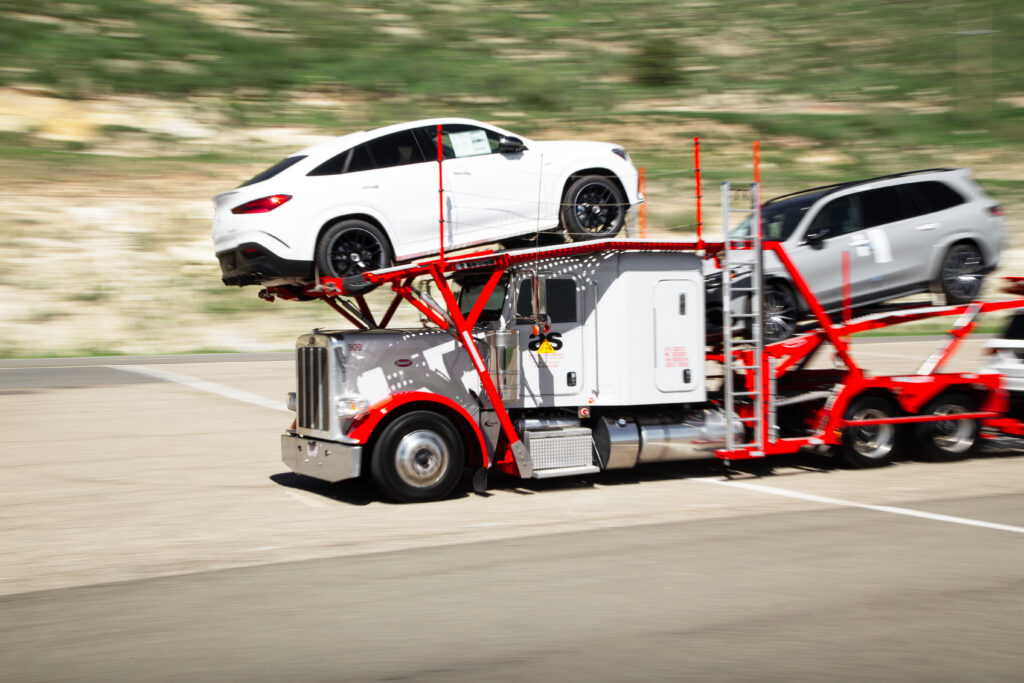
We are not a first driving job. We contract with drivers who have 3 years of CDL-A driving and 1 year of verifiable 9-car experience. Car hauling is a specialty, so our trucks take real car-haul experience.
If you are just starting, use the steps above and come back when you have the years. Our no-experience FAQ explains what it takes to get there.
Already have your 3 years and your 9-car year? The application takes a few minutes from your phone.
How to Become a Truck Driver: FAQs
What are the requirements to be a truck driver?
To drive across state lines, you must be at least 21, read and speak English well enough for the job, drive safely, be physically qualified, hold one valid commercial license, not be disqualified, and pass a road test or its equivalent.
How old do you have to be to become a truck driver?
The federal minimum is 21 to drive a commercial truck in interstate commerce. For driving inside one state only, ask your state licensing agency.
Do you have to go to truck driving school?
Before your first Class A or B skills test, you must finish entry-level driver training with a provider on FMCSA’s Training Provider Registry. Many drivers do this at a private school or community college program.
Do you need a high school diploma to drive a truck?
Federal rules do not require one. The Bureau of Labor Statistics says most companies want a high school diploma or the equivalent.
What license do you need to drive a semi truck?
A Class A CDL. It covers combinations rated at 26,001 pounds or more when the trailer is rated over 10,000 pounds, which includes a tractor-trailer.
Can a new truck driver get a car hauling job?
Each carrier sets its own bar. Accelerated contracts with drivers who have 3 years of CDL-A driving and 1 year of verifiable 9-car experience, so we are not a first job.
Ready for Car Hauling?
We run OEM plant, port and rail freight with contract drivers, and we have hauled for the automakers since 1999. With 3 years of CDL-A driving and 1 year of verifiable 9-car experience, apply today.
Want the full list first? See what we require.
Sources
Last checked September 28, 2026. Our requirements are from our careers page on that date.
- 49 CFR 391.11, driver qualifications
- 49 CFR 383.91, vehicle groups
- 49 CFR 383.25, commercial learner’s permit
- 49 CFR 383.71, driver application and training
- 49 CFR 383.113, required skills
- FMCSA, Training Provider Registry
- 49 CFR 391.21, application for employment
- 49 CFR 391.23, investigation and inquiries
- 49 CFR 395.1(e), short-haul operations
- 49 CFR 382.301, pre-employment testing
- Bureau of Labor Statistics, heavy and tractor-trailer truck drivers
- Accelerated, car hauler jobs and requirements